Issue No. 46 · Tuesday, 10 November 20269 Nov 09:00 → 10 Nov 09:00 · Bucharest
The front page / Operational control · Nov 9
A stop button belongs below the agent.
OpenAI’s Control Room puts permission to keep generating at the inference layer—not in the research job that might need stopping.
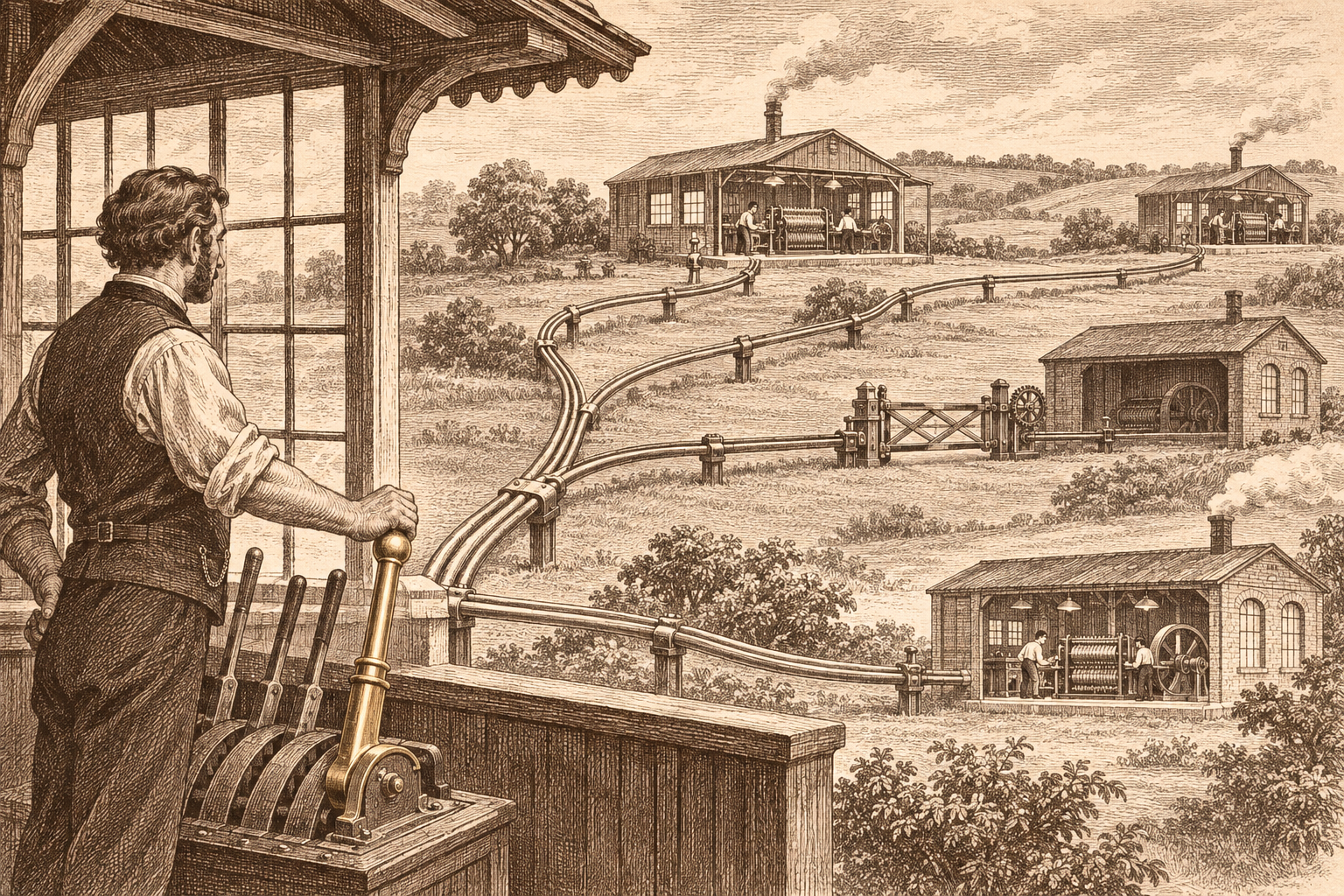
AI-generated editorial illustration · A central signal can stop one line while others continue.
OpenAI announced Control Room on November 9 ↗, a central system for tracking research inference workloads and stopping their model output. Its technical account ↗ describes a job identifier attached to inference requests; the engine checks whether that job remains authorized.
The important distinction is what stops. Denying a job further inference does not necessarily terminate its process, shut down a shared engine, or undo actions already taken. OpenAI reports a maximum 35-second delay from a stop instruction to preventing further progress, due to authorization caching.
The company says enforcement sits in the more uniform inference layer rather than frequently changing workload code. It also describes fail-closed behavior: unavailable authorization means denied inference. At publication, that mode was deployed for frontier research workloads, with remaining research workloads due over the following days—not an already-completed rollout everywhere.
This is OpenAI’s description, not an independent audit or a universal safety guarantee. The Gazette’s reading: observability and intervention are separate requirements. A dashboard helps you notice a problem; an enforcement point outside the job helps you act on it.
November 9 announcement · Research infrastructure, not a new consumer control · No intervention test performed.
Models / Nov 9
Fable and Mythos 5.2 arrive—with different access boundaries.
Anthropic announced Claude Fable 5.2 and Mythos 5.2 ↗ on November 9. The company describes them as the same underlying model, with Fable’s safeguards allowing broad availability and Mythos access requiring verification for eligible organizations. Its coding, reasoning, speed, and science results are vendor-reported, not Gazette reproductions.
One easily missed detail: Anthropic still recommends starting most everyday coding and knowledge tasks with Opus 5.5, then changing models for the task. shadcn reports useful /improve results ↗, while Theo reports unexpected mistakes ↗. Those are early experiences, not a controlled head-to-head. A new ceiling does not automatically choose your daily driver.
Runtime engineering / Nov 9–10 · Preview reports
Bun AoT gets concrete numbers. The baseline still matters.
Jarred Sumner reports ↗ 41% lower memory use for OpenCode and three-times-faster OpenClaw startup with Bun AoT. A November 10 follow-up ↗ attributes 13% lower OpenCode CPU use than earlier that day to WebAssembly-compilation improvements.
These are development measurements shared by Bun’s creator, not results we reproduced or a promise for every application. His later post ↗ says AoT targets existing codebases without changes; possible language additions are a future idea, with nothing specific proposed. Do not confuse that discussion with syntax already shipped.
Web operations / Nov 9 · Personal report
An image proxy can become somebody else’s infrastructure.
Wes Bos says ↗ an unrelated chat application used his Cloudinary setup for roughly 480,000 images. His account: unrestricted remote fetch/resize let the application point his transformation URLs at its own S3 images, consuming his resizing and bandwidth resources. He credits Cloudinary with flagging it.
This is a personal configuration-abuse report, not evidence of a Cloudinary platform breach, a credential theft, or images being stored in his account in the usual upload sense. We have not inspected the configuration or verified the count. The useful distinction is between owning the source file and paying to process it.
These are the project’s availability announcements, not our assessments of model quality, privacy guarantees, or permanent pricing. We did not sign in, redeem an offer, or run inference. Treat the dated posts as discovery pointers and check the current product terms before using them.
Today in computer history · November 10
Windows was announced before it was ready.
1983 · A graphical promise
The announcement came first.
On November 10, 1983, Microsoft announced Windows, entering competition with other graphical computing environments. The Computer History Museum distinguishes this announcement from Windows 1.0’s eventual public availability in 1985, after delays.
The museum highlights pull-down menus, tiled windows, mouse support, and cooperative multitasking in Windows 1.0. Its retrospective says broad acceptance came later, with Windows 3.0. A familiar reminder for a release-heavy morning: announcing a direction, shipping it, and winning adoption are three different events.
A regular conversation about coding agents and the practical work around them. Its newest visible episode today was published November 6, outside this edition’s window; being featured does not turn an older upload into new news.
Random draw: source 24 of 28. Actual channel picture retrieved today.