Issue No. 18 · Tuesday, 13 October 202612 Oct 09:00 → 13 Oct 09:00 · Bucharest
The front page / Shared model infrastructure
Eight hundred contributors are cataloguing the model maze
OpenCode’s models.dev has grown from an internal need into shared infrastructure: a community-maintained registry of AI model capabilities now supported by more than 800 contributors, with a second API shape already in the works.
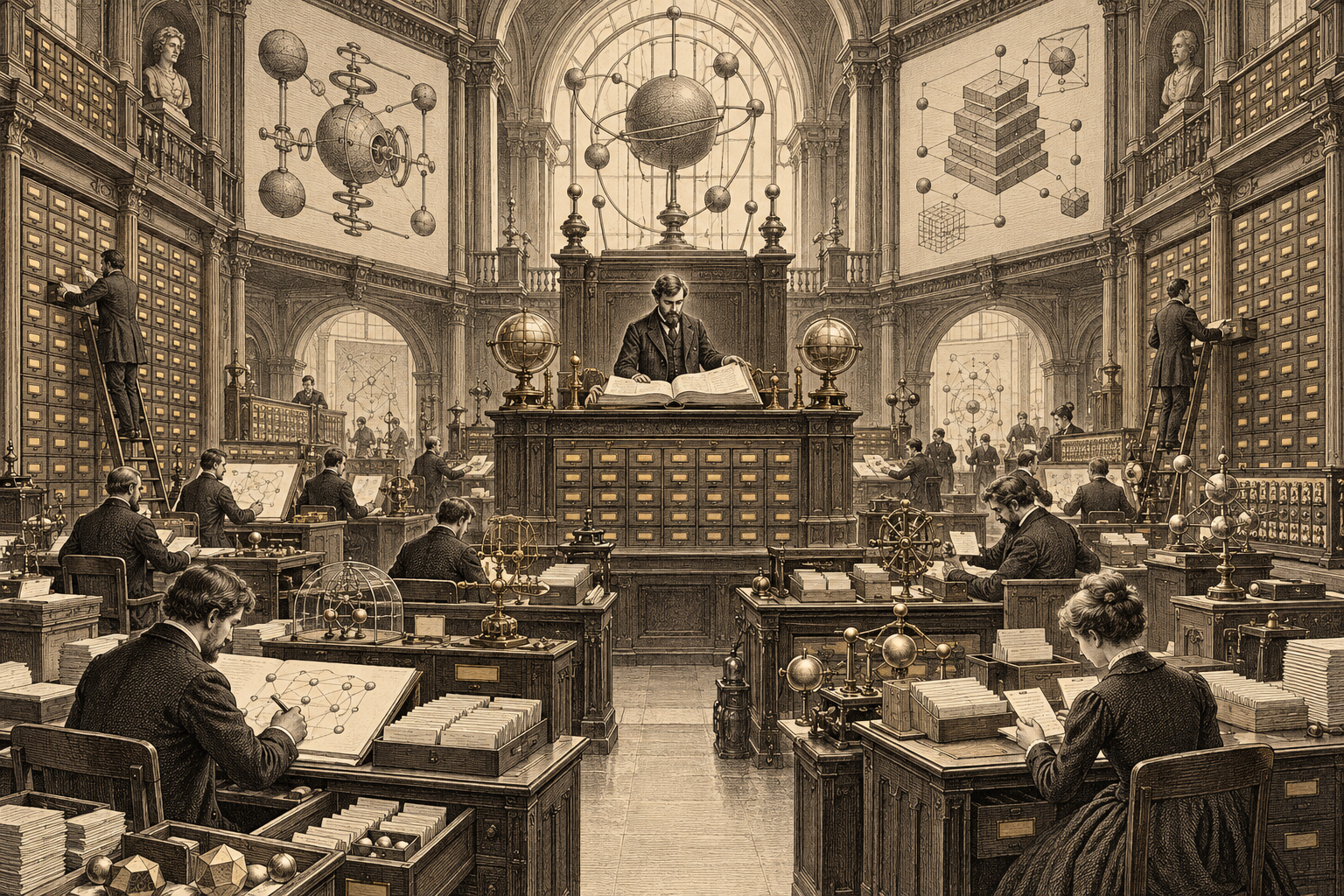
AI-generated editorial illustration · A model ecosystem needs a card catalogue as much as it needs a leaderboard.
Dax says the project began more than a year ago because OpenCode needed an authoritative list of models. On October 13, he noted that the registry now powers many other products and that work has begun on a version-two API capable of representing details the current shape cannot express. OpenCode thanked the more than 800 people who have contributed to models.dev.
The unglamorous problem is real. A coding tool needs to know far more than a model’s display name: provider identifiers, context and output limits, input modalities, reasoning controls, attachment support, pricing, and the quirks that determine whether a capability is actually safe to expose. Providers ship on different clocks and describe similar features with different vocabulary. Every client can hard-code that matrix—or the ecosystem can maintain a common map.
A public registry turns vendor metadata into inspectable infrastructure. Corrections can arrive from the people using an integration, downstream tools can share the same normalized facts, and a new release does not require every client to rediscover the same capabilities. The contributor count is not proof that every record is correct, and “authoritative” here describes OpenCode’s operational source of truth rather than a standards body.
The coming API redesign may be the most important detail. Model interfaces are expanding faster than a flat compatibility table: reasoning modes, computer-use features, tool calling, media, caching, and provider-specific controls all need room. The registry’s success will depend on whether its schema can describe that complexity without pretending the providers are identical.
Matt Pocock asked users of his documentation workflow how a GLOSSARY.md file is working for them. His own report is simple: the more effort he puts into the glossary, the more productive the agent feels because it adopts the project’s vocabulary. That is anecdotal, but the pattern is practical—stable definitions give an agent a compact map of domain language without forcing every prompt to reconstruct it.
Jared Palmer highlighted VB6 Studio Web, a browser-native recreation of the classic rapid-application-development environment. The open-source project combines a form designer, VB-style source runtime, debugger, WebGPU drawing with Canvas2D fallback, and export to a standalone HTML application. Its own documentation is careful: this is not complete native VB6 compatibility, but it is a striking demonstration of how much of a desktop IDE can now live in one browser tab.
DHH says he has already shipped two Omarchy pull requests built with Meta’s newly announced Muse Wonder model. His early verdict praises how quickly it has caught up while asking for faster maximum reasoning and a better agent overview in the default harness. This is one developer’s first-use report, not a benchmark, but shipping merged work is a more useful signal than a synthetic prompt alone.
Fireship’s new six-minute briefing follows a developer who rebuilt seven Adobe-style applications in Rust, using observable behaviour as the guide. The provocative headline—every app is “open source” whether it likes it or not—is rhetorical, but the trend is concrete: capable agents, browser automation, and rapidly generated test cases are lowering the cost of reproducing interfaces. That raises the value of workflow, service, trust, and data beyond the code users can observe.
The ENIAC designer who carried the stored-program idea forward
1915 · Arthur Burks born
A principal ENIAC designer enters the story
Arthur Burks was born in Duluth, Minnesota, on October 13, 1915. Educated at DePauw University and the University of Michigan, he became a principal designer of ENIAC—the room-sized electronic machine completed at the University of Pennsylvania’s Moore School in 1946.
After working with J. Presper Eckert and John Mauchly on ENIAC, Burks moved to Princeton University, where he helped John von Neumann develop the Institute for Advanced Study computer. His career connects two foundational chapters: proving large-scale electronic computation and shaping the stored-program architecture that followed.
 ↗