Issue No. 16 · Sunday, 11 October 202610 Oct 09:00 → 11 Oct 09:00 · Bucharest
The front page / TypeScript infrastructure
Must TypeScript leave TypeScript to get faster?
Microsoft rebuilt the compiler in Go for TypeScript 7. Jarred Sumner now says an experimental Bun ahead-of-time route can make the TypeScript 6 compiler slightly faster on one single-threaded Effect test—without translating the compiler by hand.
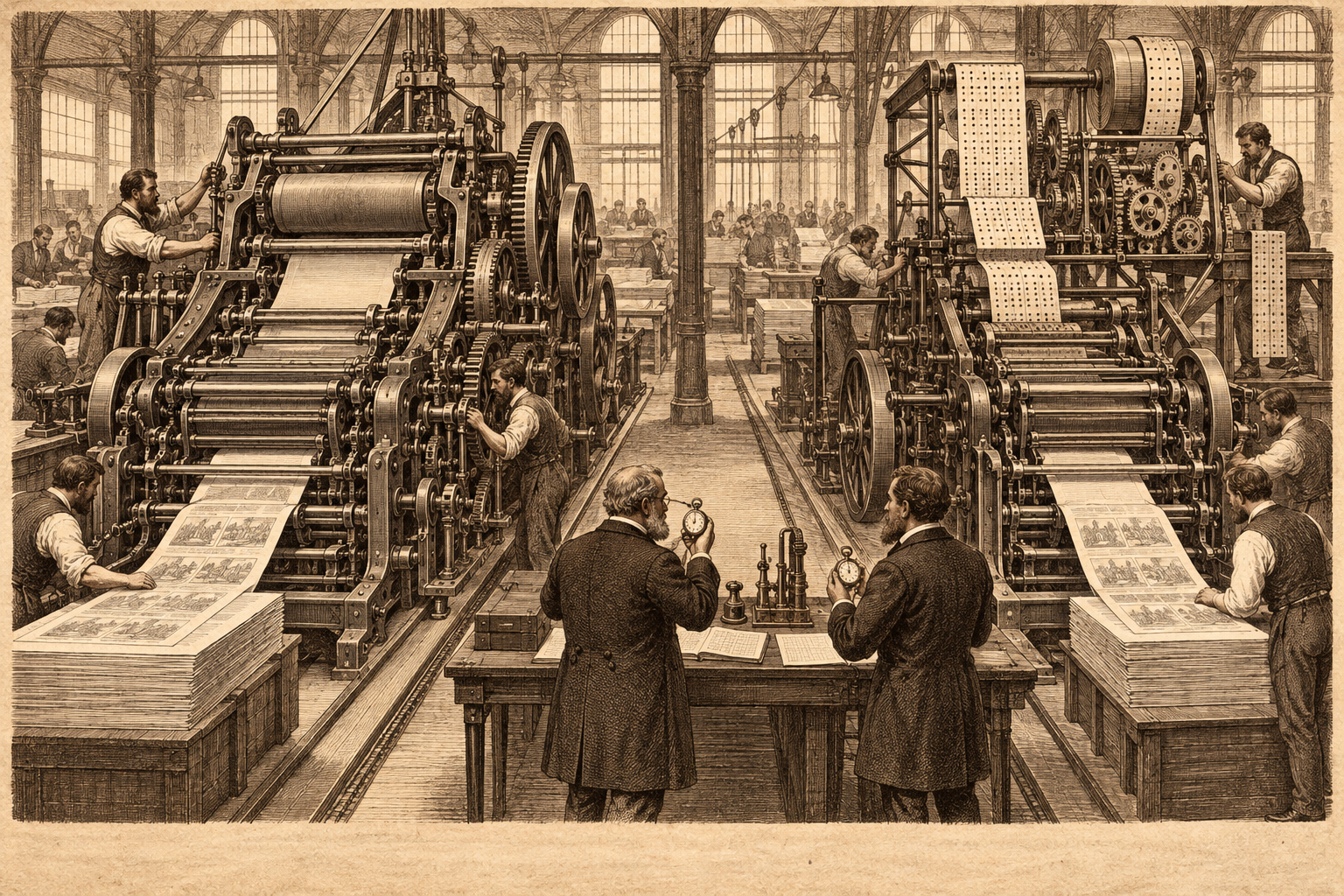
AI-generated editorial illustration · Rebuild the press, or teach the old one a faster motion?
TypeScript 7 shipped in July as Microsoft’s native Go port of the compiler and language service. Microsoft reports typical full-build speedups of eight to twelve times over TypeScript 6, helped by native code, shared-memory multithreading, and new optimizations. The port was deliberately structured to preserve TypeScript 6 semantics while changing the implementation language.
Bun is exploring a different path. Sumner reported on October 10 that TypeScript 6 compiled with Bun AoT now type-checks the Effect project slightly faster than TypeScript 7 when both run single-threaded. He immediately named the catch: declarations are not enough. To maximize the advantage over a JIT, the AoT compiler needs the package’s original .ts sources rather than only .d.ts files.
This is a promising experiment, not a new TypeScript release or a broad benchmark win. Sumner published no reproducible suite in the post, the comparison removes TypeScript 7’s multithreading advantage, and Microsoft’s compiler includes an entire editor and tooling surface beyond one type-check. Even so, the result sketches a fascinating alternative: keep a mature compiler in its original language, then make the execution substrate smarter.
The tradeoff is distribution. Native rewrites pay a large engineering cost once and ship predictable binaries. AoT can preserve a single source of truth, but only if packages expose enough source for the compiler to optimize. The speed race is becoming an ecosystem-design question: not merely which compiler is fastest, but which source, cache, and artifact conventions let optimization happen safely.
Tibo confirmed that a global Codex usage reset had propagated, restoring plan allowances without announcing a permanent limit increase. He then asked Pro users to choose between keeping five-hour limits with twice the weekly usage, or dropping five-hour limits while keeping the same weekly pool. The poll is product research, not a commitment—but it makes the underlying tradeoff unusually explicit: burst freedom and total weekly capacity are different products.
shadcn says most of his Claude Code work now happens inside Projects. Anthropic’s beta reframes a project as one ongoing conversation: Claude scopes a goal, launches parallel cloud threads, reviews the outputs, and preserves repositories, files, instructions, and memory across them. The feature is still rolling out to selected Pro and Max subscribers, and parallel threads consume plan usage faster.
Matt Pocock is considering a recommendation for his /retro workflow: turn repeated tasks into a custom CLI plus a skill, then let agents delegate to scripts they own and control. His stated gains—fewer tokens and fewer hallucinations—are plausible but not benchmarked. The deeper pattern is solid: move settled procedure out of probabilistic conversation and into deterministic, testable code.
The interview loop becomes an argument about evidence
Lauren Tan proposed compressing software-engineering interviews to system design plus an on-site project built with agents. Gergely Orosz added that weaker interview signal may increase reliance on pedigree, references, referrals, and longer trial periods. These are opinions, not measured labor-market findings, but they capture the real problem: once generated code is cheap, companies need better evidence of judgment, ownership, and execution.
On October 11, 1887, Dorr E. Felt received a patent for the Comptometer. His early adding-machine experiment was famously assembled inside a macaroni box. The commercial machine displayed one register of results and let operators enter numbers directly through columns of keys.
The Comptometer handled subtraction through nines-complement arithmetic and multiplication through repeated addition. It became successful enough that dedicated “Comptometer schools” appeared in the early twentieth century, training people to operate the keyboard rapidly and turning calculation into a specialized office profession.
 ↗