Issue No. 13 · Thursday, 8 October 20267 Oct 09:00 → 8 Oct 09:00 · Bucharest
The front page / AI & interfaces
The answer is becoming an interface
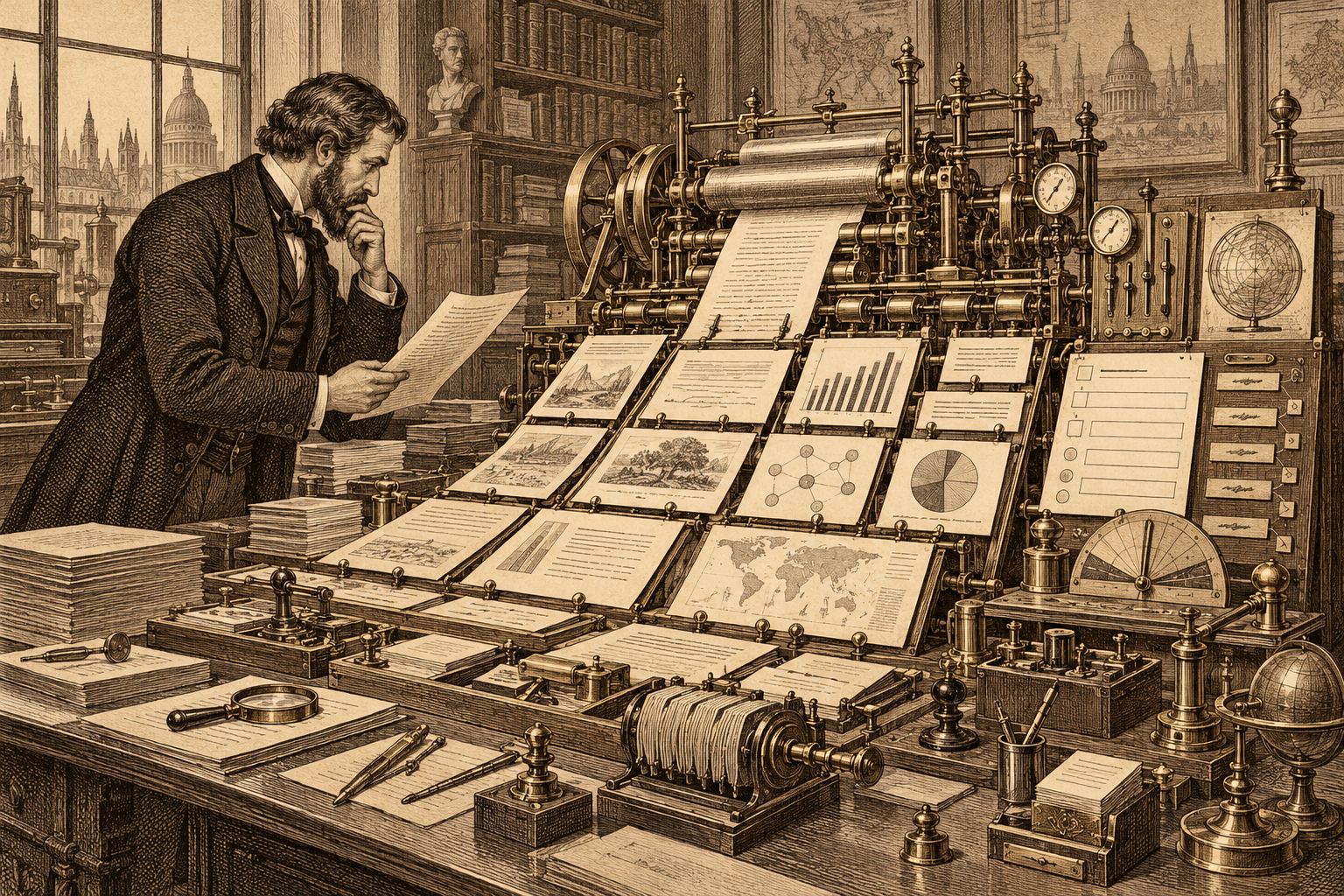
GPT-6 is rolling into ChatGPT with Intelligent UI: a model can now compose an answer from prose, visuals, controls, forms, charts, and small interactive tools instead of treating every question as a blank page for text.
AI-generated editorial illustration · One question enters; the answer chooses its own working surface.
OpenAI’s October 7 release says GPT-6 can decide when a comparison needs columns, an explanation needs a diagram, or a task needs a calculator, form, or game. The components appear progressively while the model is still thinking. Plain text remains available, and web users can reduce—but not entirely disable—visual elements in Settings.
The rollout starts with Plus, Pro, Business, and Enterprise, expanding to Free and Go on October 8. Paid Chat uses GPT-6 Sol while Free and Go use Luna. Intelligent UI works from Instant through Extra High reasoning; the Astra-powered Pro reasoning option does not support it. OpenAI also says the models powering Work and Codex are unchanged by this release.
The deeper shift is architectural. A chat model is no longer choosing only the words of an answer; it is choosing its presentation and interaction model too. That can make explanations and utilities immediate, but it also gives evaluation a second surface: the interface must be correct, accessible, legible, and faithful to the underlying answer—not merely attractive.
Anthropic launched its fastest standard-speed model for summaries, compaction, database queries, classification, support, browser use, and subagent work. Pricing starts at $0.10 per million input tokens and $0.50 per million output tokens for prompts up to 100,000 tokens; longer prompts cost more. Anthropic says average task cost is roughly 75% below Haiku 4.5, a claim that folds price and the new tokenizer together. OpenCode added the model the same evening.
A TypeScript compiler port tests trust at source scale
Theo Browne released tsc-rs, describing it as an open-source Rust rewrite of the TypeScript compiler, type checker, and language server built by agents over five months. He reports spending about $400,000 in Codex tokens without reaching the goal, then about $20,000 with Opus over two weeks, and says he has not read the code. Four of the first five filed issues, he later wrote, reproduced upstream TypeScript behavior. The implementation is available now, but his cost, completeness, and compatibility claims are not an independent audit.
Mitchell Hashimoto reports an alpha Rex server test with 10,000 simultaneous terminals using 3.8 GB of memory. Two fixes did most of the storytelling: a small C trampoline shrank per-process file-descriptor tables that Linux had rounded up dramatically, while quiet pseudoterminals moved from one blocked OS thread apiece to a shared epoll thread. The next target is 100,000 terminals. No comparison with other multiplexers was attempted, so read this as a project benchmark rather than a market ranking.
Vojta Holik’s good-css packages 47 opinionated techniques as an installable agent skill and a browsable set of live specimens. Its eight sections span foundations, layout, text, interaction, motion, and viewport behavior, with plain CSS and no framework dependency. Matt Pocock highlighted the project after years of working with Holik. The useful idea is less “teach the model CSS” than put neglected platform capabilities—such as subgrid, anchor positioning, logical properties, and OKLCH—inside its normal retrieval path.
On October 8, 1926, Julius Edgar Lilienfeld filed a patent for a “method and apparatus for controlling electric currents.” The Computer History Museum lists it as a significant early patent for a transistor amplifier. It described the field-effect idea decades before practical transistor manufacturing arrived—and before the word “transistor” was coined.
On October 8, 1996, the US Postal Service issued a “Computer Technology” stamp for ENIAC’s 50th anniversary at the Army’s Aberdeen Proving Ground. Its image—a brain partly covered by circuit boards and binary blocks—was designed entirely on a computer. Half a century after room-sized electronic calculation, computing mailed its own commemorative portrait.
 ↗