Issue No. 8 · Saturday, 3 October 20262 Oct 09:00 → 3 Oct 09:00 · Bucharest
The front page / Open-source hardware
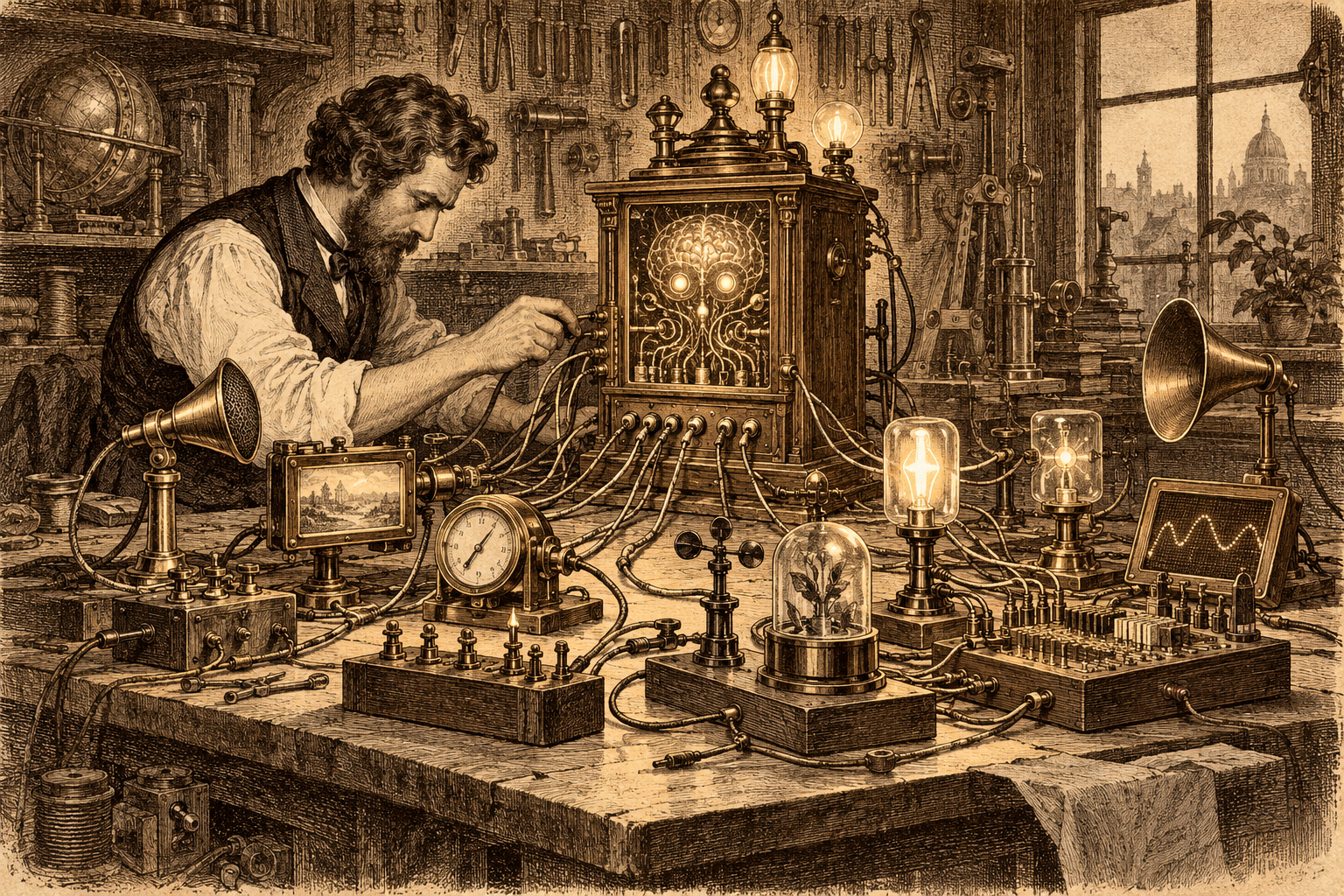
The agent wants a workbench
Muse Gadgets turns a personal AI agent into something developers can wire to ESP32 boards, Raspberry Pis, displays, microphones, sensors, switches, and local devices—with the firmware and SDKs released under Apache 2.0.
AI-generated editorial illustration · The agent leaves the chat window and finds a workbench.
The interesting part is not a single gadget. Meta’s new open-source layer gives makers an ESP32 device SDK and a Linux device SDK, then treats screens, audio, buttons, sensors, and actuators as parts of an agent endpoint. The official examples range from a pocket-size status display and a push-to-talk desk companion to a color e-ink briefing panel, an HDMI display stick, and a Raspberry Pi connected to Home Assistant.
A separate Muse Home Link can expose compatible devices and local HTTP APIs to community-built skills. Meta says its SDKs and firmware are provided as-is, with the usual risks of experimental hardware, and the Home Link offer is limited to active US subscribers. Still, the architectural direction is bigger than the promotion: a personal agent no longer has to live inside one app. It can acquire physical senses, controls, and purpose-built surfaces assembled by the people who use it.
OpenCode made InclusionAI’s Ling‑3.1‑Flash available free. The hybrid reasoning model has 560 billion total parameters but activates 25 billion per token, with a 262K context window. It is aimed at coding, multi-step analysis, and tool-using agents. Vercel’s AI Gateway is separately offering the same model free through October 13, with a dedicated -free identifier that stops rather than bills when the promotion ends.
turbopuffer’s public v3 rebuild began with some hot-query paths tens or even hundreds of times slower than v2. A new dev-log entry shows batched reads producing roughly a ninefold improvement in the full-text engine after columns had been read a row at a time. Gergely Orosz highlighted the unusual transparency: readers can watch the benchmark lines move as the team finds and removes regressions.
A new T3 Code beta can hide threads while they are running, then bring them back when they require attention. Theo Browne says the arrangement initially felt strange but made eighteen concurrent threads feel less claustrophobic. It is a small interface experiment with a large implication: parallel agents need an attention model, not merely more tabs.
Matt Pocock proposed a practical retrospective prompt: inspect the last ten coding-agent sessions, find where the agent spent too long locating relevant information or relied on stale documentation, then improve the repository’s navigability. It turns agent logs into maintenance evidence—and treats token waste as a symptom of information architecture rather than only model quality.
On October 3, 1950, the US Patent Office issued John Bardeen, Walter Brattain, and William Shockley a patent for the transistor. Their Bell Labs team had tested the first working device in 1947. The small, low-power switch replaced bulky vacuum tubes and became the foundation for integrated circuits, microprocessors, and modern computers.
British engineer Alec Reeves filed a French patent on October 3, 1938 describing pulse-code modulation: sampling an analog signal and representing each sample digitally. Vacuum-tube circuitry made the idea impractical at first; transistors later unlocked it. PCM now underpins digital telephony and familiar uncompressed audio formats.