Issue No. 12 · Wednesday, 7 October 20266 Oct 09:00 → 7 Oct 09:00 · Bucharest
The front page / AI & science
New mathematics enters the public ledger
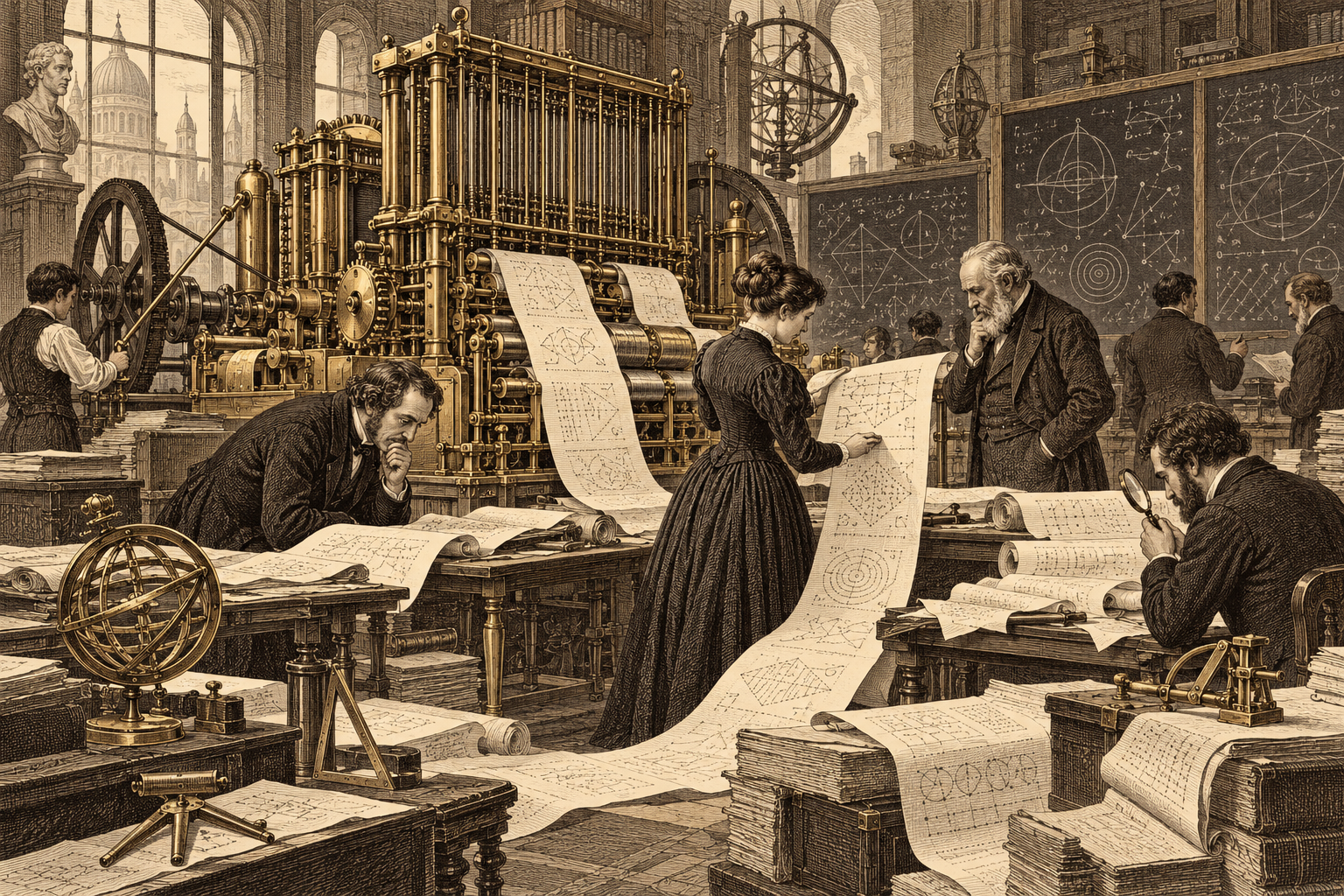
OpenAI has published a broad collection of mathematical results from an internal frontier model, with papers, revision protocols, research details, and machine-checkable versions of many proofs.
AI-generated editorial illustration · Discovery leaves the engine; verification begins at the desk.
The October 6 release is unusually inspectable for an AI-research announcement. Its public repository contains 722 manuscripts grouped into 372 families, plus revision and citation protocols. Many—but not all—have Lean formalizations that let computers check the proofs. OpenAI explicitly warns that some unformalized results may contain errors.
The company also published ten summaries of model reasoning, attempted-problem statistics, and compute estimates. It says the average result used roughly the equivalent of three hours of ChatGPT Pro thinking. OpenAI consulted the independent Advisory Group on Mathematics and Artificial Intelligence at the Institute for Advanced Study and acknowledges that future papers need better citations, exposition, and presentation.
The important next step is mathematical scrutiny. Publication makes these claims available for reproduction, criticism, correction, and extension; it does not turn a model-generated argument into accepted mathematics by announcement alone.
Next.js 16.4 makes Cache Components the starting point
New create-next-app projects now enable Cache Components by default, ahead of the model becoming the framework default in Next.js 17. Existing apps gain an agent-assisted upgrade command and optional upgrade reminders. The release also brings React 19.3, 20–25% smaller Turbopack disk caches, lazy server updates, and smaller shared runtimes. Several compiler and cache-cleanup features remain experimental.
Programs can tell the terminal what they are doing
Mitchell Hashimoto published OSC 7501, a general-purpose terminal escape-sequence proposal for reporting idle, working, blocked, finished, or failed states—and a reason. Because the signal travels through the existing pseudoterminal, it can work through SSH and containers. Terminals and surrounding tools can decide whether to show a notification, status icon, inbox item, or something else. It is a specification proposal, not yet a universal terminal standard.
OpenAI’s new endpoint turns text or images into typed predicates, fixed choices, or rubric scores. The documentation positions it for routing, classification, and prioritization, reporting responses around ten times faster than the Responses API. GPT-6 Luna is the only supported model during public beta. That speed comparison comes from OpenAI, and the API is intentionally narrower than general structured generation.
Tibo Sottiaux’s Day 2 roundup included usage-free automatic approval review, a simplified builder API, meeting-note integration, and the Decisions API. After a community vote, he then announced a reset despite calling the four changes good to great. The unusual format makes prioritization public, but the practical value still depends on how each change behaves in real workflows.
On October 7, 1954, IBM demonstrated a prototype calculating machine built with solid-state transistors instead of vacuum tubes. The experimental machine pointed toward the IBM 608, a commercial transistorized calculator introduced later in the decade. Its data still arrived on punched cards, but the switching technology belonged to computing’s next era.
The first round of the Computer Bowl was held on October 7, 1988. The annual televised quiz matched computing “gurus” from the East against “wizards” from the West. Mitch Kapor and Bill Joy were named the first round’s most valuable players and earned places on the all-star team. Before esports filled arenas, computing already had a game show.
 ↗