Issue No. 11 · Tuesday, 6 October 20265 Oct 09:00 → 6 Oct 09:00 · Bucharest
The front page / AI & provenance
A faint signature in the words
OpenAI is extending provenance to text: API customers can opt in now, with eligible ChatGPT and Codex output in the EU following over the coming weeks.
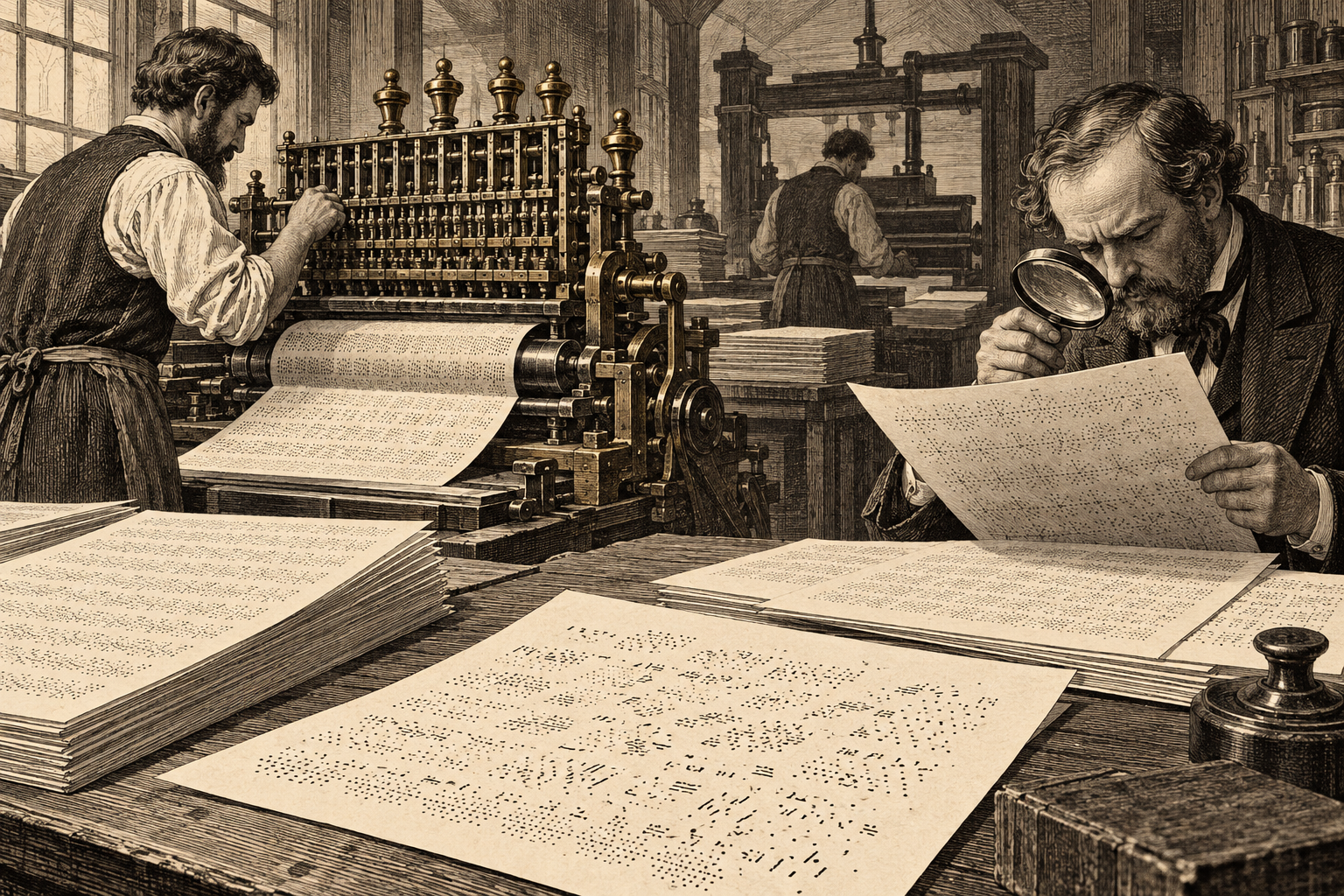
AI-generated editorial illustration · A pattern can survive the press and still be disturbed by the editor.
The October 5 announcement introduces a statistical signal in word choice. Worldwide API opt-in applies to select models and remains off by default. The EU rollout is phased; detector access initially goes to approved researchers and expert organizations. It is not a detector anyone can freely use at launch.
OpenAI’s own evaluations show why interpretation matters. Detection varies with text length and subject, and synonym substitutions can weaken the signal sharply. False positives and missed watermarks remain possible. A watermark does not establish accuracy, ownership, or how much a human contributed; absence does not establish human authorship.
Our reading: this adds evidence about origin, while leaving editorial judgment essential. Developers integrating the option should distinguish an attribution signal from a decision about whether text is trustworthy.
Tanner Linsley shared the launch of a chart library designed to start small and grow with a product. Its typed, tree-shakable grammar composes marks, scales, interactions, and motion for SVG or Canvas. The docs now promise a stable 1.0 API and provide a migration guide; React Native remains experimental. Claims about small bundles and fast updates come from the maintainers, rather than an independent benchmark.
Guillermo Rauch introduced gdp-ts, a library, lint rules, and an agent skill for requiring evidence of authorization before sensitive operations. Shadcn highlighted the approach. A trusted runtime check returns a proof bound to specific values; downstream TypeScript functions require that proof. The design makes missing or mismatched checks easier to catch during development. Its guarantees still depend on correct runtime checks and lint enforcement against forged proofs.
Following yesterday’s improvement pledge, OpenAI’s Tibo Sottiaux reported roughly 50% faster default speed for GPT-6 Astra and GPT-6.1 Sol through subscriptions. He said the change extends across products and partners using Sign in with ChatGPT, including OpenCode, with no user action required. This is a reported service optimization; it does not establish that an entire coding task finishes 50% sooner.
Mitchell Hashimoto announced public testing for Superlogical, initially on macOS. Access is being granted in mailing-list signup order, with expansion planned. For readers following the project, this is the next concrete opportunity to try it; the announcement describes a staged test rather than unrestricted general availability.
Lotus went public on October 6, 1983, barely a year after Mitch Kapor and Jonathan Sachs founded it. Lotus 1-2-3 combined spreadsheet calculations, graphics, and data retrieval in one package. The Computer History Museum records $12.8 million in revenue over the preceding twelve months: a reminder of how quickly a useful PC application could turn into a major business.
Among the Computer History Museum’s preserved Apple II DOS materials is a line-printer source listing dated October 6, 1978. DOS 3.1 had shipped earlier that June; this date belongs to the surviving listing, not the release. The archive even includes a later retyped version, with possible transcription errors noted. Sometimes software history is rescued one printed line at a time.
 ↗