Issue No. 9 · Sunday, 4 October 20263 Oct 09:00 → 4 Oct 09:00 · Bucharest
The front page / Agent engineering
The best agent is the one with rails
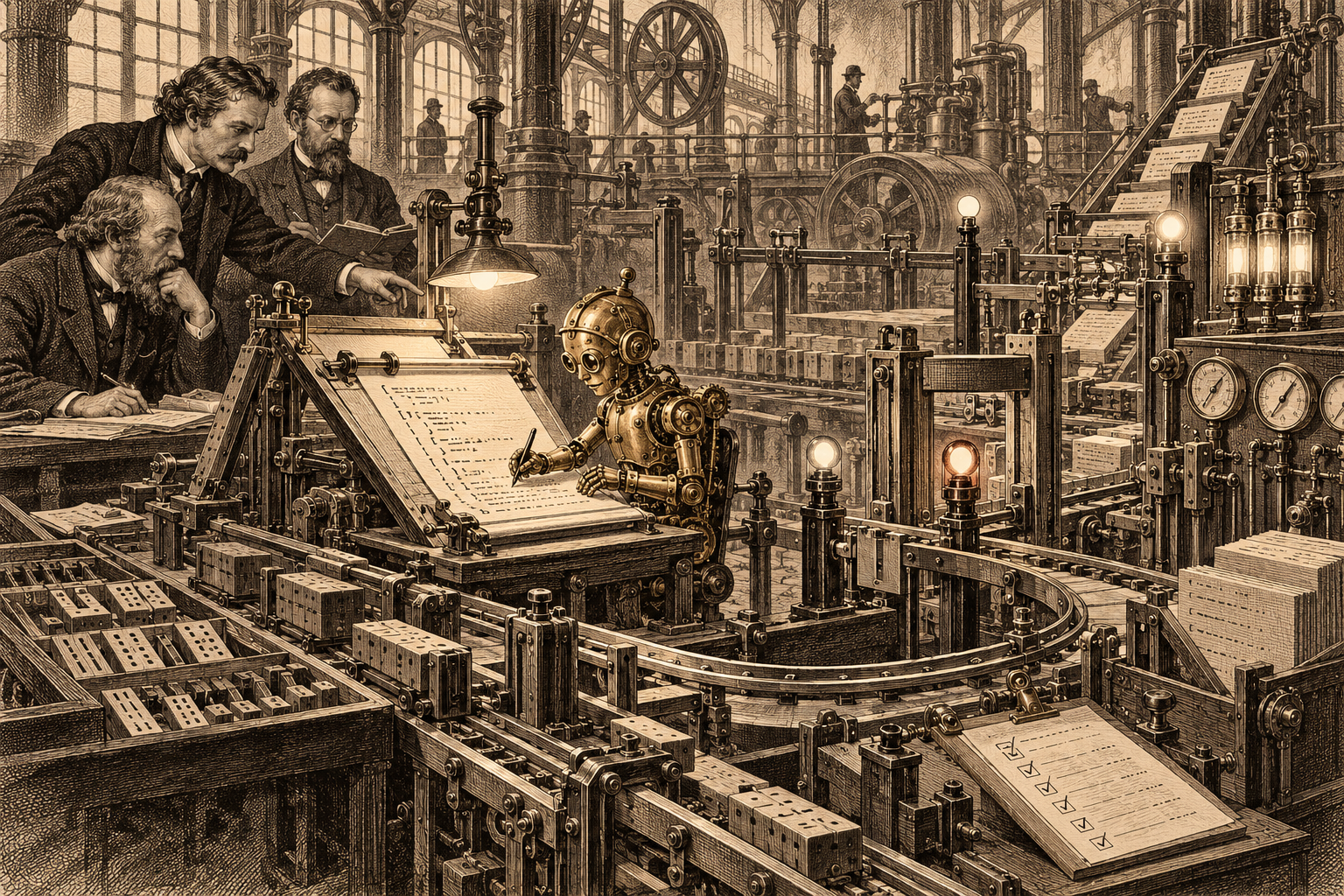
Three builders arrived at the same answer from different directions: coding agents improve when the surrounding system narrows their choices, returns fast feedback, and makes bad work difficult to represent.
AI-generated editorial illustration · Intelligence earns leverage when the workshop supplies rails, gauges, and tests.
Matt Pocock argued for more abstraction in the AI age, not less. High-leverage APIs let an agent accomplish more with less code, while strict lint rules can shrink the design space to safer decisions. His sharpest formulation followed soon after: make bad code unrepresentable. The claim cuts against the idea that agents only want raw code and unlimited freedom.
Gergely Orosz supplied the organizational version of the same argument. Companies that already invested in platform engineering, release pipelines, automated and manual testing, feature flags, canaries, observability, experiments, and migrations have verification layers ready for agents to use. Dax supplied the language-level version: types give agents a feedback loop. Put together, the lesson is plain. The model matters, but the rails around it increasingly decide whether speed becomes reliable output or merely faster rework.
ThePrimeagen described a computer-use experiment that adjusts candidate probabilities and recenters them before choosing an icon. In his demonstration, the technique turned a request to click a monitor icon into the correct target. It is a small but tangible example of agent reliability moving from prose prompts into explicit decision machinery.
Sam Altman said he was uncomfortable with efforts to give AI models religious force or surrender human judgment to them, calling that posture a real safety issue. The post offered no technical prescription, but its boundary is useful: capability is not moral authority, and fluent output does not remove human responsibility.
DHH argued that treating AI as merely another tool misses the category shift. His preferred analogy is a group of highly capable coworkers with whom you may disagree. Whether or not the metaphor fits every workflow, it points toward a management problem: delegation, review, and accountability become as important as invocation.
OpenAI’s Tibo Sottiaux asked users for the single thing they most wanted Codex to add. The question drew thousands of replies inside the edition window, turning one short post into a broad public backlog. It is not a roadmap, but it is a strong signal that the next agent improvements may be shaped as much by workflow friction as by benchmark gains.
John Vincent Atanasoff was born on October 4, 1903. Working with graduate student Clifford Berry at Iowa State College, he later designed the Atanasoff–Berry Computer: an electronic machine that used binary arithmetic, capacitors for memory, and regenerative storage to solve systems of linear equations.
On October 4, 1957, the Soviet Union launched Sputnik 1, the first artificial satellite. Its simple repeating radio beeps could be detected around the world, while scientists tracked its orbit from changes in the signal. The launch began the Space Age and accelerated the computing, communications, and control systems needed for everything that followed.
Fast, opinionated commentary and experiments spanning programming, developer tools, systems work, and the rapidly changing practice of building with agents.
One source is randomly selected for each edition and remains fixed in its archive.