Issue No. 14 · Friday, 9 October 20268 Oct 09:00 → 9 Oct 09:00 · Bucharest
The front page / AI infrastructure
Ultrafast turns latency into a line item
GPT-6.1 Sol can now run in OpenAI’s fastest tier across the API, Codex, and ChatGPT Work. The gain is immediate—up to eight times faster token generation in Codex—but the meter spins faster too.
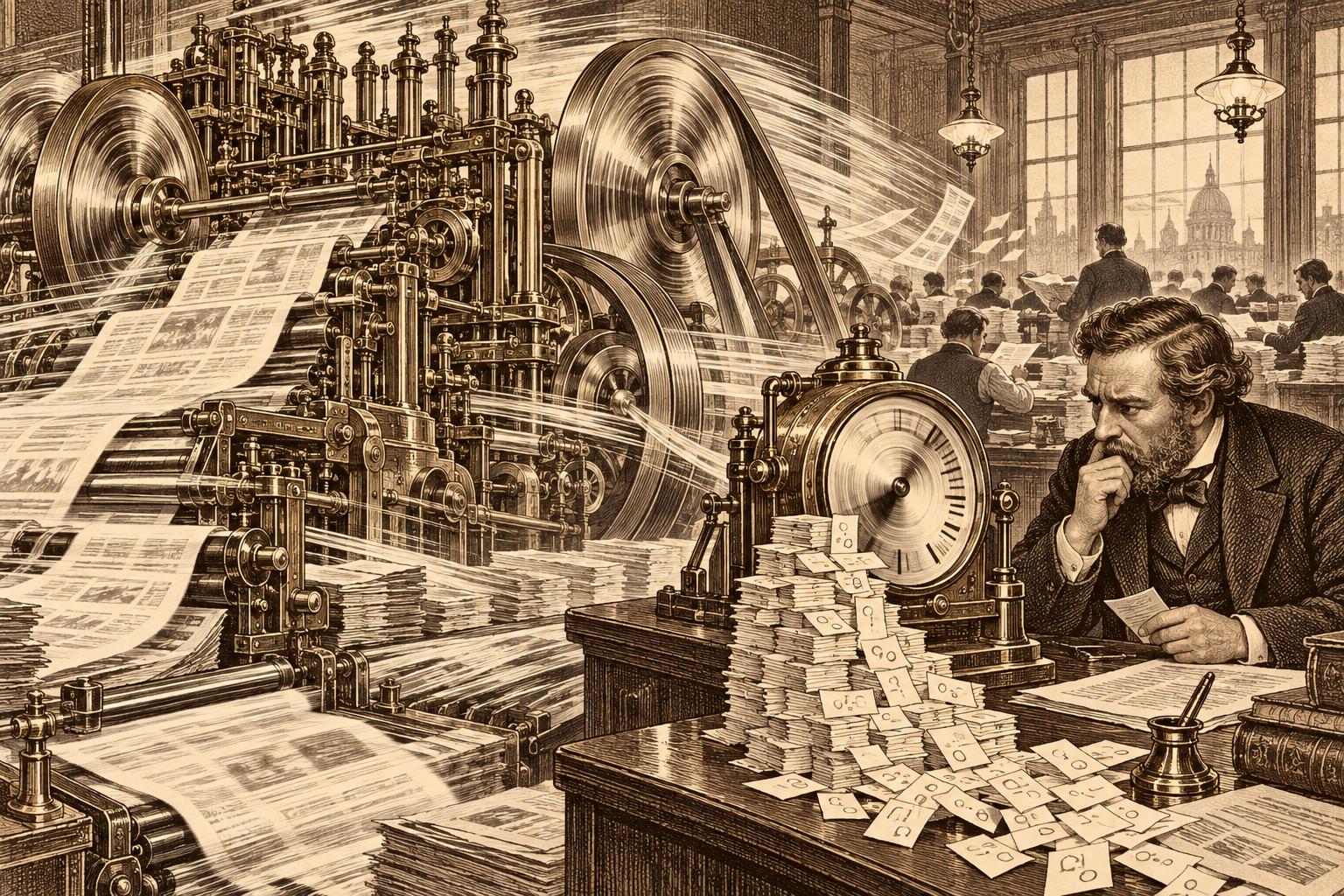
AI-generated editorial illustration · The press runs faster; the editor still watches the meter.
OpenAI’s October 8 changelog adds Ultrafast mode for GPT-6.1 Sol. In the API, developers select gpt-6.1-sol with service_tier: "ultrafast"; it is available to all API users subject to separate rate limits, with global processing plus US and EU inference residency. OpenAI recommends WebSockets for tool-heavy agents so repeated connection overhead does not consume the latency win.
In Codex and ChatGPT Work, Ultrafast is limited to Pro $500 and eligible Enterprise and Edu plans. OpenAI says it can generate tokens up to eight times faster than Standard. That speed consumes included subscription usage at 8× the Standard rate, while purchased credits and Enterprise pay-as-you-go usage are billed at 6×. Enterprise access is off by default until an owner enables it.
This is more than a faster toggle. It makes latency an explicit systems decision: use the expensive lane where a human is waiting, a tool loop is serial, or rapid iteration changes the outcome; keep batch work, long searches, and unattended jobs on cheaper tiers. The interesting optimization is no longer simply “which model?” but “which moments deserve speed?”
Harness acquired select Augment Code assets: Cosmos, the Auggie CLI, the Code Context Engine, and related technology. The team behind those products will join Harness. Cosmos is being recast as the Harness Cosmos Software Factory Agent, carrying work from an event or ticket to merge-ready code; Harness’s delivery, security, runtime, and cost agents are meant to carry it onward to production. This is an asset acquisition, not a claim that Harness bought the entire company.
Jarred Sumner says Bun 1.5 ships Wednesday and will add three entries to a list that already includes a Node-compatible runtime, npm-compatible package manager, Jest-compatible test runner, and esbuild-compatible bundler. The teaser did not name the three additions, so there is nothing yet to benchmark or audit. A separate post lamenting that bun lint and bun format were not reserved offers a clue, not a release note.
Claude Code speaks a common terminal status language
Claude Code v2.1.295 added OSC 7501 program-status support, allowing a terminal application to report structured state without painting it into ordinary output. Mitchell Hashimoto says Anthropic engineers tested the implementation against Rex. The small protocol-level addition matters because agents, multiplexers, and terminal UIs can coordinate progress through a shared channel instead of scraping prose or inventing one-off escape sequences.
OpenCode says Step 5 Preview is free in its Zen model service for one week, with a one-million-token context window, multimodal input, and zero data retention. Those are provider claims and the temporary price should not be mistaken for general availability or long-term economics. Still, a million-token preview inside a coding-agent workflow gives developers a practical way to test whether ever-larger context improves repository work—or merely makes mistakes more expensive.
A contract for the computer between ENIAC and UNIVAC
1947 · BINAC gets under way
Northrop orders a binary automatic computer
On October 9, 1947, a contract was signed to develop BINAC—the BINary Automatic Computer—for Northrop Aircraft. It became the only machine completed by the Eckert-Mauchly Computer Company, founded by ENIAC pioneers J. Presper Eckert and John Mauchly, before the company moved on toward UNIVAC.
The Computer History Museum describes BINAC as the first completed electronic digital computer in the United States with stored-program capability. Its 512-word memory sounds tiny, but its roughly 700 vacuum tubes were a dramatic reduction from ENIAC’s 18,000. The contract price was $278,000—serious money for a machine that helped bridge two eras of American computing.
 ↗