Issue No. 17 · Monday, 12 October 202611 Oct 09:00 → 12 Oct 09:00 · Bucharest
The front page / Agent working memory
Half a million tokens becomes the new working desk
OpenAI has raised GPT-6.1 Sol’s default context in Codex and Work from 272K to 500K tokens. The model still supports overrides up to 1M—but a larger desk changes how long projects survive before their details must be compacted.
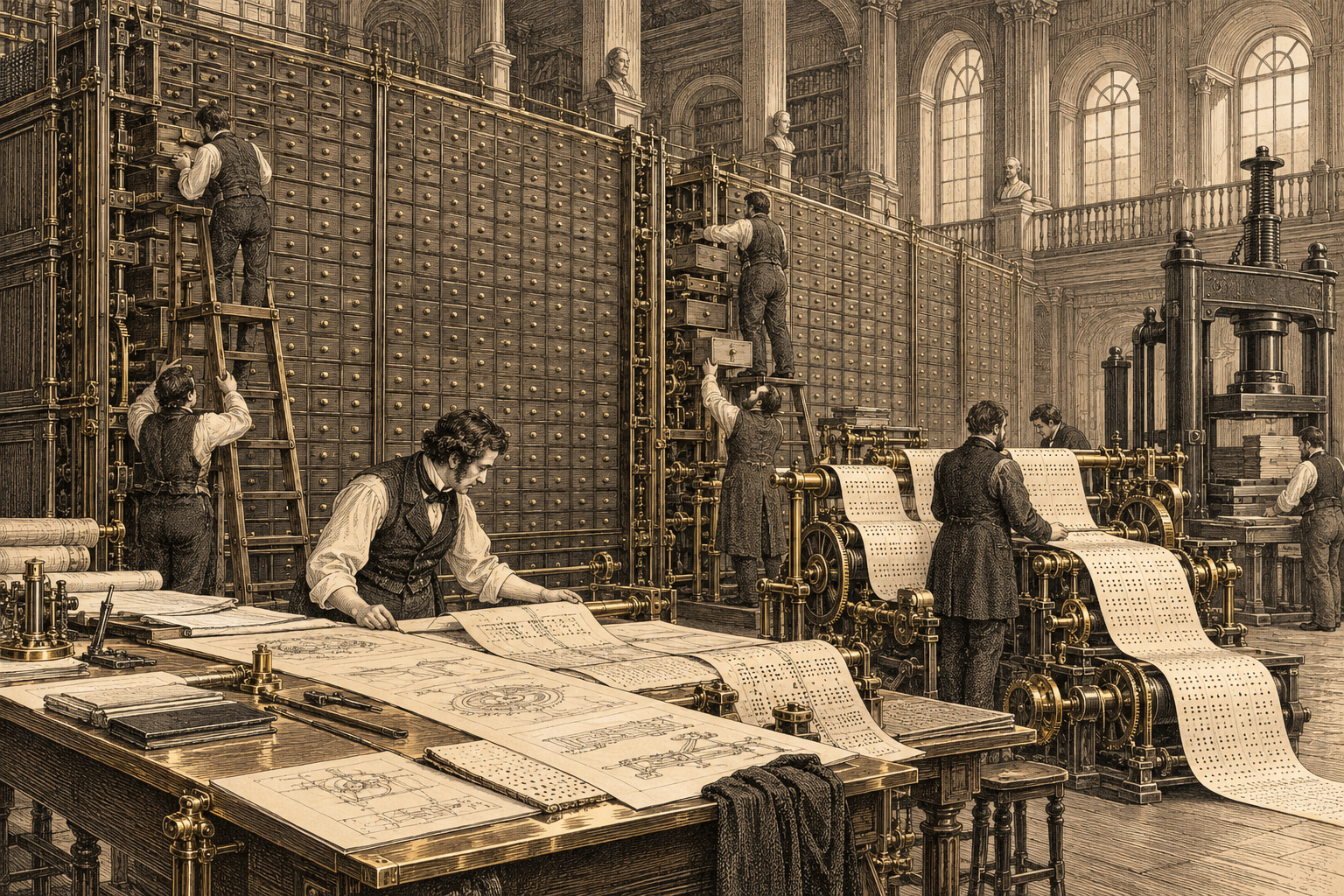
AI-generated editorial illustration · More drawers for the working set, fewer trips to the compaction press.
Tibo announced the new default early on October 12: 500K tokens for GPT-6.1 Sol when used through Codex and Work, roughly eighty percent more than the previous 272K default. Users can still choose another value, up to the model’s 1M-token maximum. He says the setting was tested as the best balance for most users; that product judgment is not an independent benchmark.
Context is not permanent memory. It is the material the model can actively inspect during the current job: instructions, conversation, source files, tool output, plans, and revisions. When that working set becomes too large, an agent compacts earlier detail into a shorter representation. A bigger default should make those transitions less frequent and preserve more nuance across long implementation or research sessions.
The extra room is not a promise that every buried fact will receive equal attention. Long contexts can dilute what matters, stale material can linger, and larger API inputs carry latency and token-cost consequences. Nor does a bigger context ceiling imply unlimited subscription usage. Good project hygiene—focused instructions, durable files, explicit decisions, and deliberate checkpoints—still matters.
The more important shift is architectural. Coding agents are becoming persistent workspaces rather than one-shot prompt boxes. The winning experience will not simply expose the largest number; it will decide what stays live, what is summarized, what belongs in files, and how users can see those transitions. Five hundred thousand tokens gives that operating system more breathing room.
Mitchell Hashimoto highlighted Rex’s new Activity Mode, which shows active and idling processes and agents for faster context switching. The interface is powered by OSC 7501 program-status signals. Mitchell credits the implementation’s quality to weeks spent refining exactly when each UI state appears—a useful reminder that a protocol supplies facts, while product craft decides when those facts become legible.
Matt Pocock’s experimental /chief-of-staff skill is attempting to replace OBS with a home-built recorder. To measure latency, the agent asked him to play a generated video on his phone, point it at the camera, route sound through the microphone, record all inputs, and compare the result with OBS. This is anecdotal, not a product benchmark—but it demonstrates an agent designing an unusually thorough physical-world test while the human supplies the sensors.
Theo says T3 Code nightly now has a proper /goal flow and a visual callout. The post does not document scheduling, autonomous repetition, or completion semantics, so it should not be read as a full workflow specification. Still, making the goal an explicit, visible object is a meaningful UI move: it separates the enduring destination from the next transient prompt.
shadcn added color tags to Copper, his local-first Mac scratchpad for AI-assisted work. The feature is modest, but the surrounding design argument is larger: he says AI still has not accelerated the weeks spent finding the right abstractions and interfaces. Copper’s role—capturing prompts, notes, and reusable fragments between applications—suggests that the human organization layer remains a product in its own right.
The expensive black cube that pointed toward the web
1988 · NeXT Computer unveiled
Steve Jobs introduces the NeXT machine
On October 12, 1988, Steve Jobs unveiled the NeXT Computer, conceived after his departure from Apple. The $6,500 system failed to become a mass-market success, but its ambition was unmistakable: an optical storage disc, a built-in digital signal processor capable of supporting voice recognition, and an object-oriented software environment.
NeXT Computer eventually became NeXT Software, and Apple acquired the company in 1997. Its technical lineage proved more durable than the original hardware. The episode is a classic computing pattern: a commercially unsuccessful machine can still supply the abstractions, tools, and people that shape the next successful platform.
Creator of Ghostty and co-founder of Superlogical, sharing unusually concrete notes on terminals, agent interfaces, software craft, and the protocols beneath modern developer tools.
Randomly selected from our 28-source reading list. The account’s actual X profile picture is shown. This selection stays fixed in the archive.
 ↗