Issue No. 40 · Wednesday, 4 November 20263 Nov 09:00 → 4 Nov 09:00 · Bucharest
The front page / Exploratory QA
A small blank panel is a useful test of a big idea.
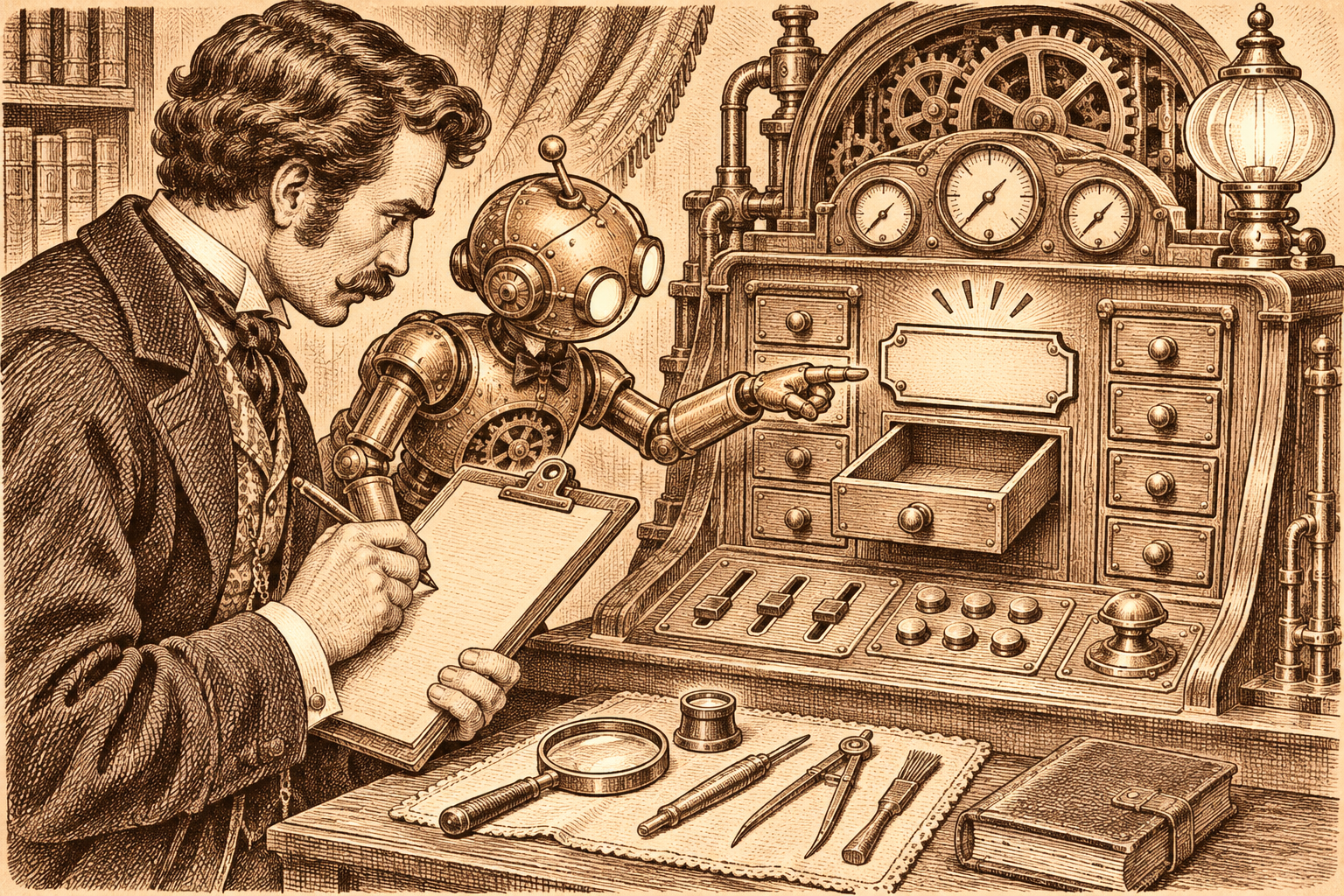
ThePrimeagen’s experimental agent QA work on Omarchy has produced a concrete clipboard report. It is a more useful starting point than a sweeping claim that testing can now run itself.
AI-generated editorial illustration · Notice a failure, explain it, and leave evidence another person can check.
DHH’s November 3 post ↗ describes a goal of linking agentic bug fixes, pull requests, QA, and releases. ThePrimeagen’s later update ↗ points to a specific result: a clipboard panel that showed a blank card when its history was empty or its filter matched nothing.
Pull request 17492 traces the missing messages to a layout dependency: a column’s width came from its children while the text children took their width from the parent, resolving to zero. The proposed change keeps the texts’ implicit widths and centers them horizontally. The author includes before-and-after screenshots and describes rerunning the same interaction sequence on a branch-built ISO.
The status matters. The pull request was created November 3 at 22:12 UTC and was still open and unmerged when checked for this edition. Its reproduction and validation are the author’s report; the Gazette has not run the ISO or independently verified the fix. Nor does one UI defect establish a coverage rate for an autonomous QA system.
The Gazette’s reading: exploratory testing earns its keep by noticing behavior a checklist did not explicitly name. A blank state is especially revealing because the failure may look like “nothing happened,” not an exception. Finding that silence, translating it into a reproducible case, and proposing a narrow change are separate achievements.
The next step should be evidence that survives the excitement of the demo: which build failed, which interaction exposed it, what changed, and what was checked afterward. This report offers several of those ingredients. The larger release pipeline remains a plan, not an accomplished end-to-end result.
Faster parsing does not guarantee a faster-looking cat.
Mitchell Hashimoto reports new libghostty throughput improvements and planned backports to 1.4.1. His follow-up supplies an important boundary: for plain ASCII/Unicode on Linux and macOS, libghostty already processes data faster than the kernel supplies it through a PTY. Those improvements therefore do not automatically translate into visibly faster cat output. A component benchmark and end-to-end experience answer different questions. We have not repeated the measurements, and the post is not a confirmation that 1.4.1 has shipped. Measurements post ↗ · The PTY qualification ↗
Apple / Nov 3 · Supplemental primary source
Siri AI opens a developer door—not an App Store launch.
Apple’s new Developer Preview lets applications expose custom actions through App Intents, with skills combining actions and broader Spotlight entity support. It is available for exploration in the 27.3 betas; App Store submissions for these experiences are planned for spring, with more usage-policy details still to come. Apple also says Siri AI remains unavailable in the EU on iOS, iPadOS, and watchOS, and requires supported devices and languages. “Open to developers” is not “available to every customer today.” Apple’s dated announcement ↗
OpenAI / Nov 3
From code to engineering for physical products.
OpenAI describes work spanning mechanical design, electrical engineering, simulation, and coordination between disciplines. The announcement reports faster internal iteration and early evidence from industry collaborations. It is a progress report, not independent certification that generated designs are safe to manufacture. The relevant handoff still includes specialist tools, engineering checks, and the requirements of the physical product. Original report ↗ · Source-roster announcement ↗
Today in computer history · November 4
When the computer’s prediction waited for permission
1952 · CBS and UNIVAC
An early election-night forecast.
On November 4, 1952, CBS used a borrowed UNIVAC computer to analyze early returns in the Eisenhower–Stevenson presidential election. The Computer History Museum records that the machine forecast an easy Eisenhower victory.
The museum says Walter Cronkite and Charles Collingwood were wary of the computer’s accuracy and delayed announcing its prediction until an Eisenhower victory became clear. The historical curiosity is not just a correct forecast, but the decision about when to trust and broadcast it.
A recurring voice in our reading list on TanStack and application development. Today’s random feature rotates independently of headline selection; no fresh post from him was visible in the public timeline we could read.
Random draw: source 14 of 28. Actual profile image retrieved today. The roster uses the correct handle @tannerlinsley.