Issue No. 20 · Thursday, 15 October 202614 Oct 09:00 → 15 Oct 09:00 · Bucharest
The front page / Software maintenance
Fourteen hundred pull requests against software entropy
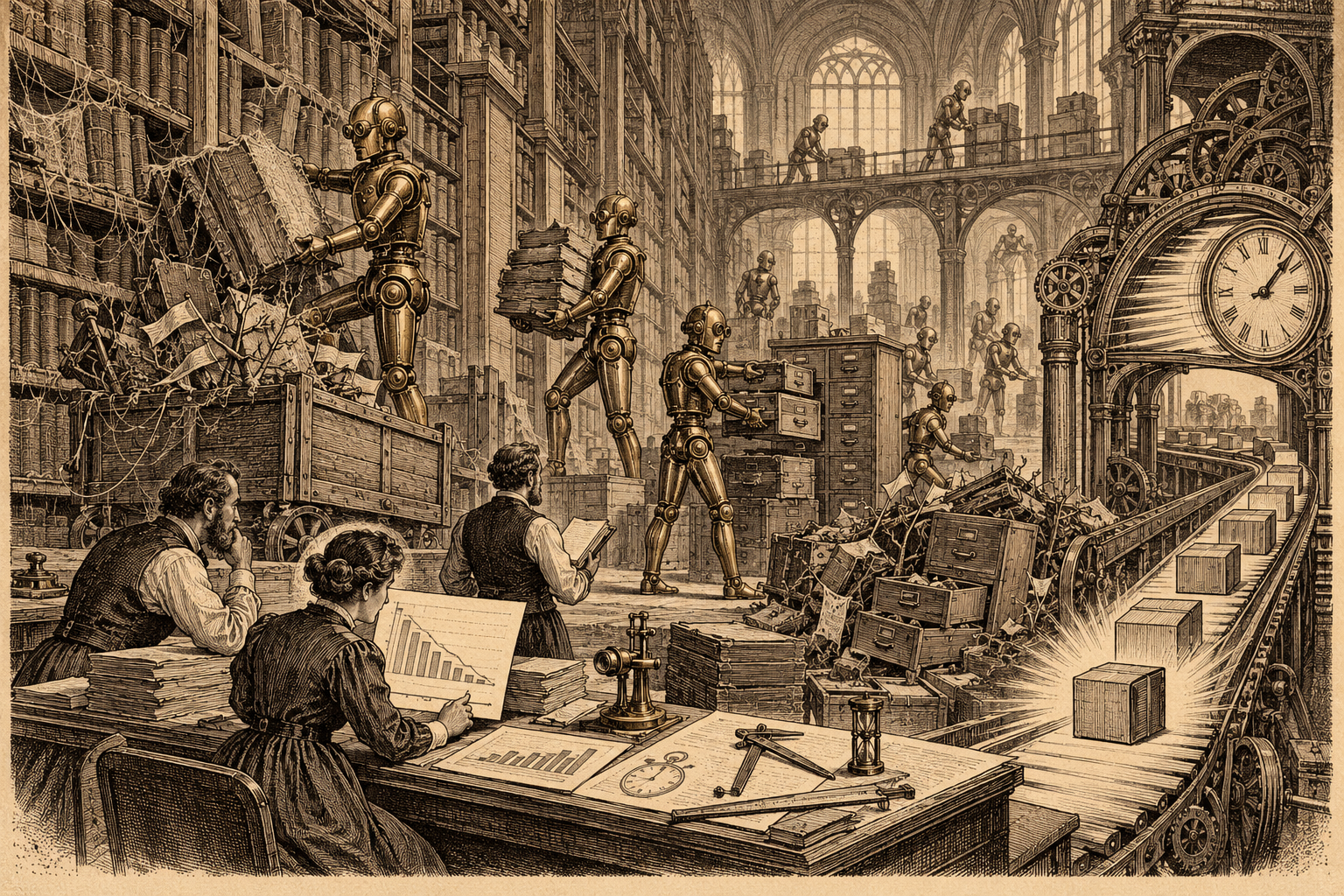
OpenAI says five engineers, working part-time for two weeks, used the GPT-6 family and Codex to merge more than 1,400 maintenance pull requests and delete over 800,000 lines. The striking result is not merely scale—it is a glimpse of maintenance becoming continuous, evidence-driven agent work.
AI-generated editorial illustration · Agents turn the maintenance backlog into a measured production line, with humans still responsible for evidence and judgment.
The Core Experimentation team did not ask an agent to perform one heroic rewrite. It pointed agents at the slow accumulation of dead code, stale experiments, redundant visual snapshots, and wasteful continuous-integration paths. OpenAI reports that one service container fell from 3.31 GB to 1.72 GB and that roughly 400 obsolete snapshot variants disappeared. A single permanent feature flag was also traced through its operational fan-out and removed, with an estimated 0.42 percent CPU saving.
The method matters as much as the deletion count. GPT-6 Astra reportedly audited Slack, pull requests, trackers, and production-profiling evidence before proposing work. That makes the agent less like a clever linter and more like an investigator reconstructing why code exists. Review remained essential: OpenAI says some proposals added more complexity than the problem justified, so engineers started small, measured the result, and expanded only when the change held up.
The model economics are unusually concrete. Across more than 6,000 files and one million lines, Astra Ultra found 142 opportunities at $109.06 in API cost; Sol Ultra found 131 at $15.12; Sol Medium found 86 at $5.27. In OpenAI’s own comparison, Sol Ultra produced 92 percent as many findings as Astra Ultra for about 14 percent of the API cost. That is not a universal benchmark, but it is a useful reminder that maintenance agents need a portfolio strategy, not always the largest model.
Around 30 CI optimization pull requests cut the team’s reported median pipeline time from 10 minutes to 4.5, and p90 from 12.5 minutes to 6. One missing mock reduced a 63-test suite from 592.6 seconds to 29.8. The bigger lesson is sober: agents can finally make neglected maintenance economically attractive, but only when they can gather context, produce measurable claims, and pass ordinary human review.
shadcn released Trace and Code Block alongside 21 copy-owned AI Elements patterns. Trace gives reasoning, tools, sources, plans, and subagents one visual grammar—with pending, running, and error states plus nested paths and accessible keyboard behavior. Code Block handles code, terminals, logs, and diffs inside or outside that trace. AI Elements replaces AI SDK Elements without forcing an immediate migration; export names and props remain compatible.
In a new analysis of its own enterprise sample, OpenAI says Codex and ChatGPT Work now account for more than half of output tokens, while weekly active use among EU small and medium businesses has grown 8.1-fold since May. The country range runs from 22 percent in Slovenia to 85 percent in Lithuania. These are OpenAI’s product and customer measurements—not independent market-share estimates—but they show how quickly the unit of work is shifting from chat to delegation.
OpenCode made Gemini 4 Argon available through OpenCode Go with a promotion offering $60 of usage for $10 through November 30. Separately, co-founder Dax Raad said OpenCode 2.0 is heading toward two million daily active users. The offer is directly verifiable; the audience figure is a founder’s self-report, not an independently audited metric, and no capability claim is inferred from the model’s availability.
A shutdown discovers that most projects fit the free tier
Sunil Pai’s latest PartyKit shutdown note says roughly 9,000 inactive projects have been deleted, about 2,400 users emailed, and 96 percent of remaining projects appear to fit within Cloudflare’s free tier. New deploys stop Friday as the hosted service moves toward its announced closure. Those figures come from the project author, but the update is a useful operational snapshot of what a graceful platform exit actually entails.
IBM released the first FORTRAN reference manual on October 15, 1956—about six months before the first compiler was ready. The 60-page document, set in large type with generous margins, described a language tiny by modern standards but revolutionary in ambition: scientists could express formulas instead of wiring their thinking directly to machine instructions.
A language becomes a practical engineering project
John Backus led a team that included Sheldon Best, Richard Goldberg, Lois Mitchell Haibt, Harlan Herrick, Grace Mitchell, Robert Nelson, Roy Nutt, David Sayre, Peter Sheridan, and Irving Ziller. Their compiler work helped prove that a higher-level language could generate efficient programs—and changed what working with a computer could look like.
 ↗