Eight tiny keys shake a very large chain of trust.
The machinery around a certificate authority is supposed to make trust expensive to counterfeit. Eight eMudhra intermediate keys reduced that machinery to at most 256 guesses—and the repair is now rippling through browsers, root programs, servers, and the long tail of devices that update slowly.
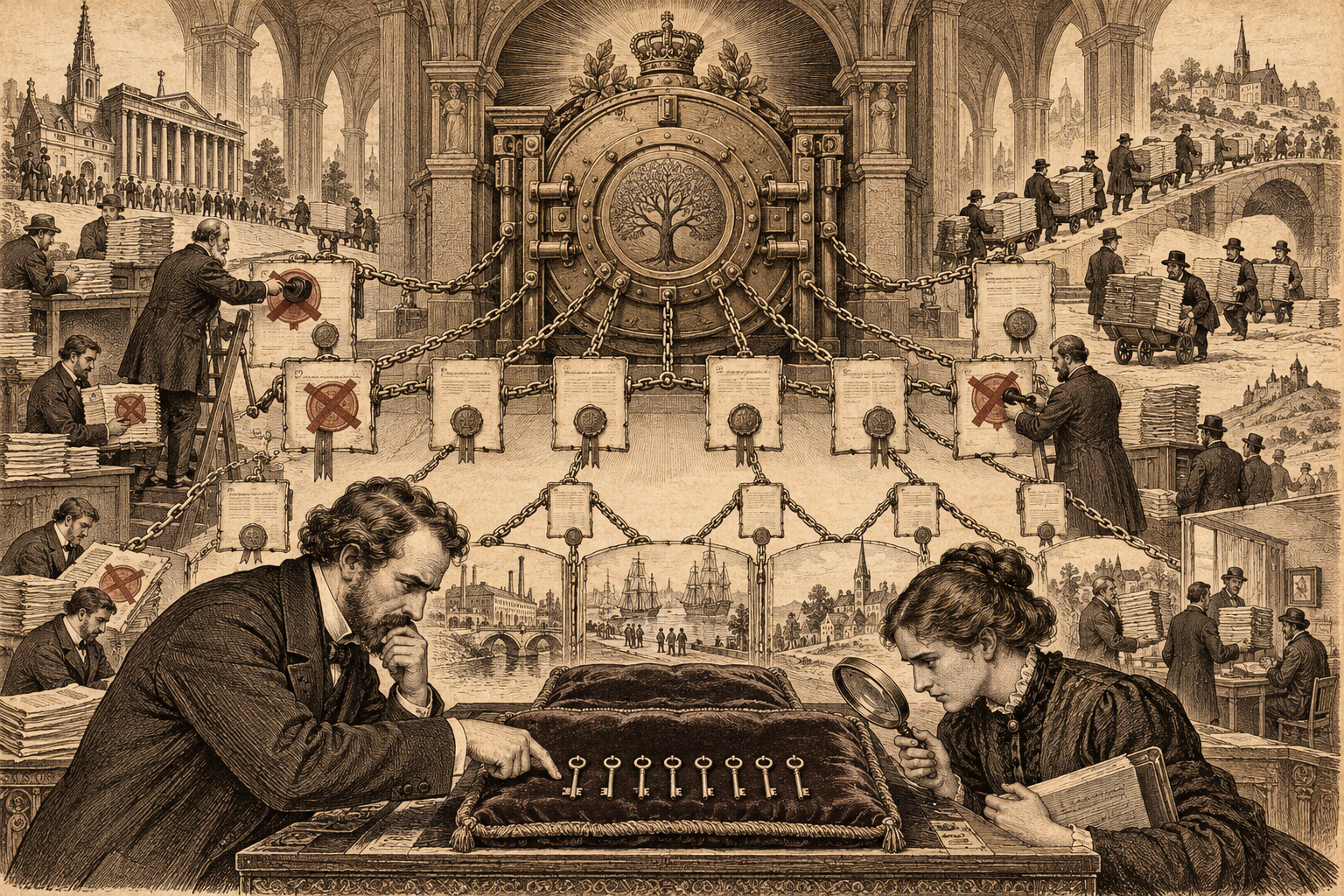
On October 17, Mozilla received a proof that the private keys for eight eMudhra intermediate certificates had been recovered. It confirmed the proof within minutes, independently recovered the keys, and pushed the affected certificates into Firefox’s OneCRL distrust mechanism that evening. Six intermediates were for TLS and chained to roots recognized by major browser programs; two were for code signing and trusted by Microsoft.
The cryptographic failure is almost comic in scale. A P‑384 private scalar should be chosen from an astronomically large range. The eight affected values were all smaller than 256—effectively zeroes followed by a single byte. An attacker could derive them by generating the first 256 possible keys. The elaborate hierarchy still looked like public-key infrastructure; the secret at its center had the strength of a one-byte PIN.
eMudhra says the intermediates came from an April 30, 2025 key-generation ceremony, that all eight have been revoked, and that no end-entity certificates were issued from them. Those assertions reduce evidence of active abuse, but they do not answer the root-program question: how did a controlled ceremony and hardware security modules produce—or accept—keys that a browser engineer could recover almost instantly?
Mozilla’s public incident thread is now asking for the generation script, ceremony and witness records, HSM model and validated mode, logs, and the exact wrap-or-unwrap mechanism that created the second weak key set. A promised initial response missed its first deadline. In this edition’s window, Gergely Orosz argued that the explanation still does not add up and predicted that browser root programs will remove eMudhra’s G1 root. That remains his forecast, not a completed browser decision.
The repair illustrates why revocation is a distributed-systems problem. Modern browsers can ship distrust quickly; servers, package managers, runtimes, embedded devices, and old clients do not all inherit the same updates at the same speed. One tangible downstream response arrived in T3 Code’s October 24 nightly: its server preview browser now explicitly rejects the compromised intermediates.
The Gazette’s reading: trust is not the ceremony, the certificate, or the audit badge. It is the whole path from key generation to monitoring, public disclosure, revocation, software updates, and the oldest relying device. When one link can be guessed in 256 tries, the rest of the chain has to prove it can notice—and move.
 ↗