Issue No. 21 · Friday, 16 October 202615 Oct 09:00 → 16 Oct 09:00 · Bucharest
The front page / Scientific computing
The lab gets the keys to specialized AI
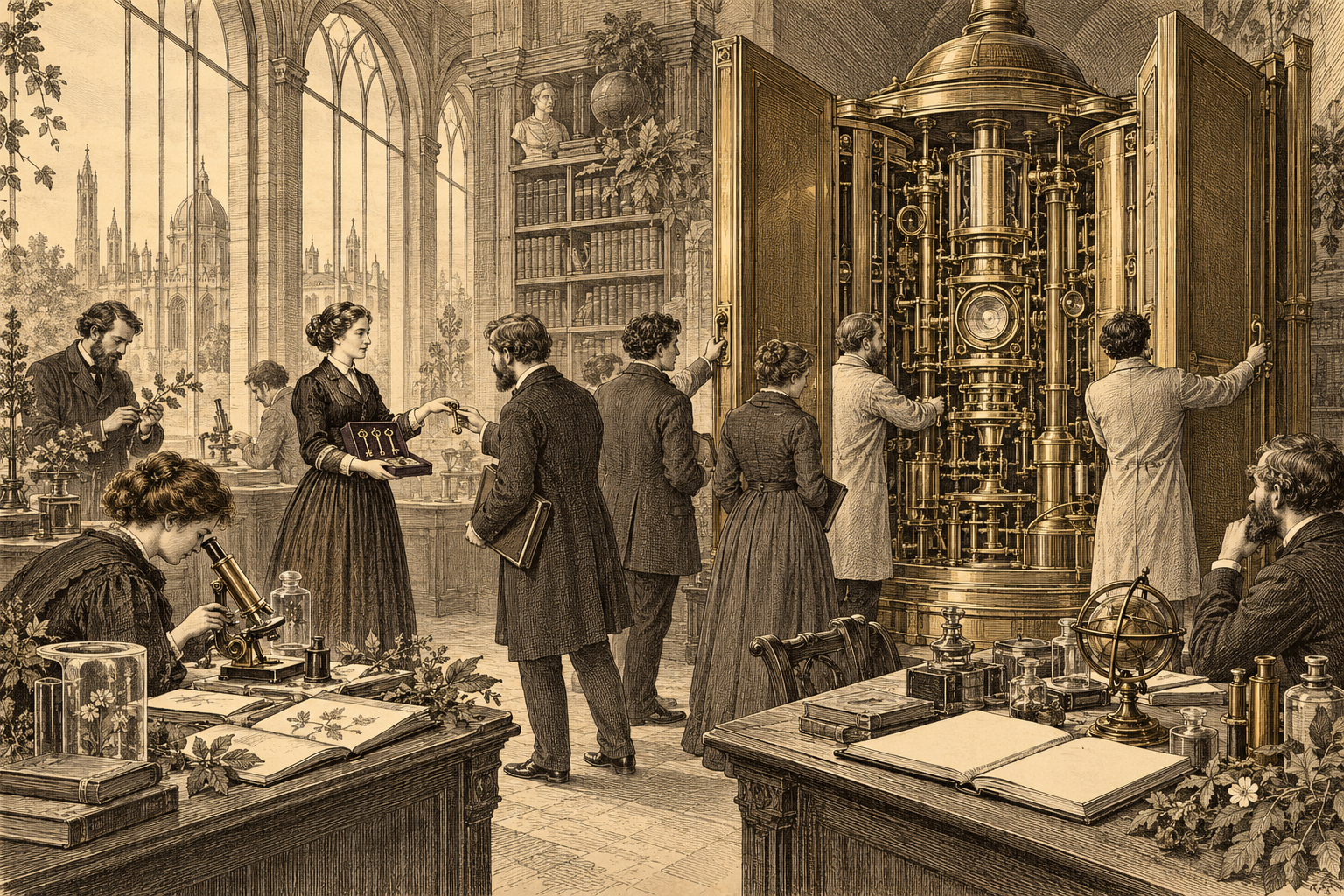
OpenAI’s October 15 Rosalind Academic Plan offers approved U.S. university labs up to 30 free Business Standard seats for up to a year, including access to its specialized life-sciences model. This is an access program, not a new model release—and the conditions matter.
AI-generated editorial illustration · Opening the laboratory door is only the beginning; expertise, evidence, and oversight still belong inside.
GPT-Rosalind combines specialized scientific reasoning with a workbench for orchestrating research tools. The plan targets workflows such as literature review, research-data analysis, and writing analysis code, using ChatGPT and Codex in a shared lab workspace. OpenAI says research data is not used to train its models by default. That should not be confused with zero retention: the help guide explicitly says standard retention applies and Zero Data Retention is unavailable under this offer.
The eligibility boundary is narrow. A principal investigator or designated lab lead applies for the group; a university email address alone does not guarantee acceptance. Institutions already covered by an Enterprise agreement must use that institutional route. The academic offer does not include API credits or API usage, and its complimentary seats retain normal product usage limits. For Romanian and other non-U.S. labs, this particular application route is not currently open.
Approval also does not automatically activate every researcher. The verified lead manages named members and model permissions, while the application requires an institutional biosafety contact. Identity checks are only one part of trusted-access review. The support guide also requires members to use the same institutional email domain as the approved lead, which limits how visiting researchers and cross-university collaborators can join.
The Gazette’s reading: the important engineering story is access design. A powerful domain model needs an application path, accountable administrators, data-handling rules, and clear exclusions before it becomes useful institutional infrastructure. Sponsored seats reduce one barrier; they do not establish scientific correctness, replace experiments, or remove the cost of careful evaluation.
Fifteen million dollars for understanding AI’s mathematics
The Simons Foundation, Anthropic, and OpenAI announced $15 million in combined funding and resources to help mathematicians evaluate AI-assisted results, learn tools, and shape shared standards. Simons will manage and award the funding, including through an open call. OpenAI’s separate October 15 update identifies its contribution as $5 million, plus model and computing access for supported researchers. This funds the work of scrutiny and understanding; it does not certify the earlier AI-generated results as correct.
OpenCode’s current first-party documentation lists deepseek-v4.1-flash-free separately from the paid model, with free input, output, and cached reads. It says the offer is temporary, follows a zero-retention policy, and does not use submitted data for training. October 15 reports put the free route’s context at 200K, but the retrieved first-party page does not specify that limit, so this edition does not treat it as independently confirmed. Availability and data terms are verified; exact launch timing and context remain less certain.
Mitchell Hashimoto says Rex invited roughly 2,000 people this week and began another 1,000-person wave, after 250 invitations the previous week. Nearly 50,000 people were still waiting, according to the same post. Those are the developer’s own rollout figures, not an adoption audit or a public-launch announcement. The post was discoverable through search indexing, while direct X retrieval failed.
Hashimoto also reiterated his longstanding preference for forking dependencies, cutting them to the actual use case, and updating only when users need a change. That is an engineering position, not a security guideline. The Gazette’s counterweight: owning a smaller fork can simplify a system, but it also transfers responsibility for vulnerabilities, compatibility, and upstream fixes to the team that keeps it.
Control Data Corporation released the CDC 1604 on October 16, 1959. Designed by Seymour Cray, it was the first computer line from the company formed by William Norris and colleagues who had left Sperry Rand. The Computer History Museum describes it as the most powerful computer of its day.
The 1604’s applications ranged from real-time data processing and weapons-system control to large scientific calculations and commercial work. Cray would go on to build supercomputers, but this earlier machine already showed the breadth of problems that fast general-purpose computing could take on.
Long-form conversations about software engineering, AI, and how the profession’s tools and roles are changing.
Randomly selected from our 28-source reading list. The channel’s actual YouTube picture, verified for the previous edition, is reused. A random draw can select the same source on consecutive days. This selection stays fixed in the archive.
 ↗