Issue No. 35 · Friday, 30 October 202629 Oct 09:00 → 30 Oct 09:00 · Bucharest
The front page / Browser boundaries
A preview is not permission.
New research argues that embedding a browser inside an AI coding tool can quietly change its trust boundaries. The question is not whether a page looks ordinary, but what the surrounding application lets it reach.
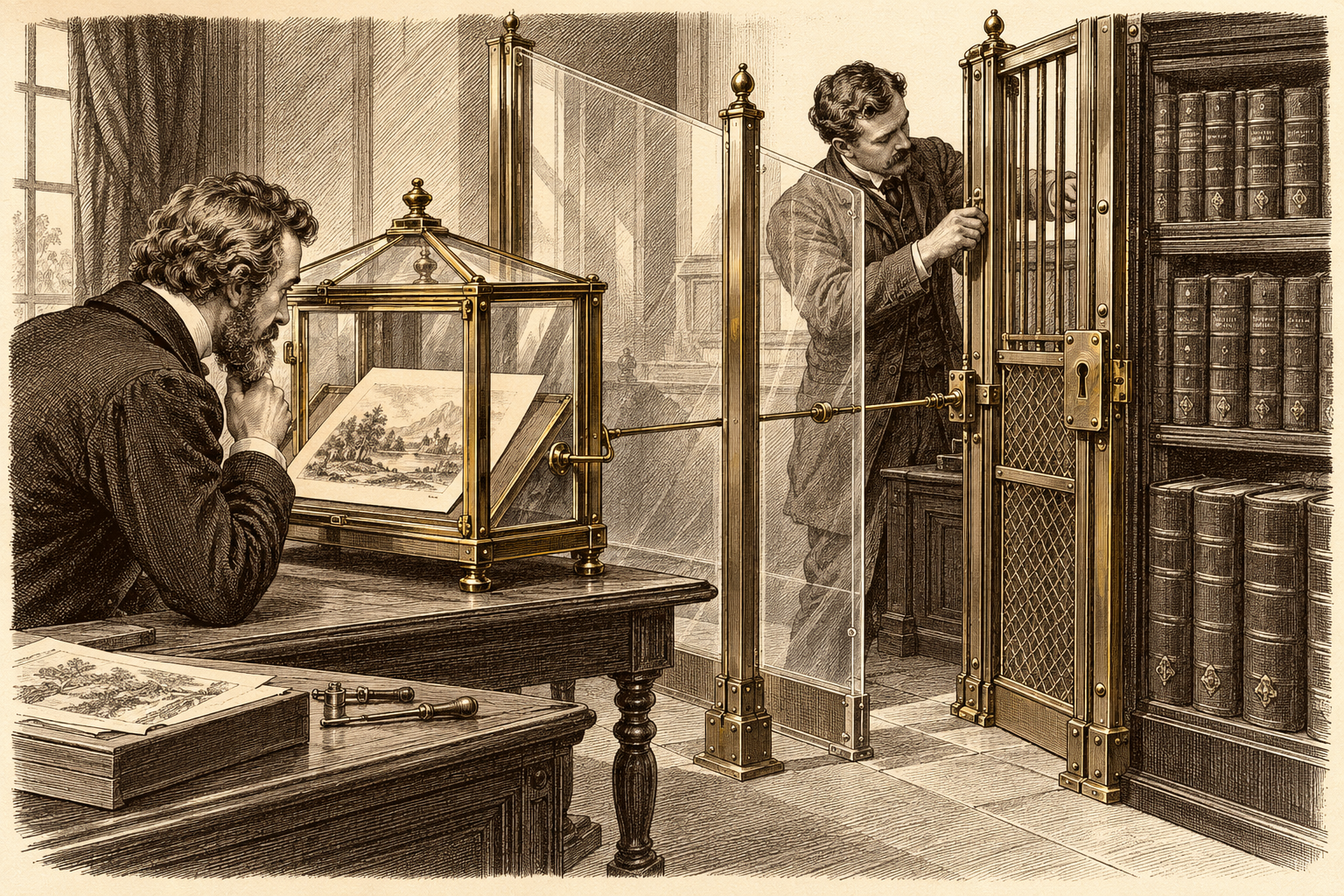
AI-generated editorial illustration · Looking at a document and granting it authority are different acts.
Forever Security’s October 29 EMBRACE report examines embedded browsers in Cursor, GitHub Copilot, Codex, VS Code, and Claude Desktop. The researchers describe different failures, not one shared vulnerability: page content reaching an agent’s command interface, a page influencing the displayed address, and local previews reading files beyond their intended project boundary.
The technical account distinguishes the mechanisms. In its Claude Desktop and VS Code tests, a project-scoped restriction on the main page did not protect reads performed inside a web worker. Its Codex example reports no corresponding file-read fence on the main page. The Cursor demonstration depends on model behavior and a user approval gesture; it is not described as deterministic exploitation of every visit.
Patch status is also product-specific. Forever says Cursor’s reported issue was patched October 1 and that GitHub independently fixed the address-spoofing issue in Copilot 1.1.29 on October 13. It describes the Codex and VS Code findings as unresolved when its report was published October 29. That is the researcher’s dated account—not a fresh Gazette audit of every current build or a vendor-confirmed universal exposure.
We have not reproduced the attacks, run the proof-of-concept code, or established that our own publishing environment is affected. The report’s examples should not be flattened into “every AI assistant can read every disk.” The affected integration, local-file behavior, workspace trust decisions, and software build all matter.
The Gazette’s reading: an attractive preview can hide a very consequential capability boundary. A system may correctly refuse instructions inside a page and still expose too much filesystem access to that page’s scripts. Conversely, a hardened rendering process does not make page-supplied instructions authoritative. Model behavior and application isolation are separate layers; neither can substitute for the other.
The practical review question for teams is architectural: which process opens the content, which paths can it read, and which bridge can ask the host to act? Document those boundaries before treating an integrated browser as merely another editor panel.
OpenAI’s October 29 revision reorganizes its public Model Spec around faithfulness to human intent, harm minimization, honesty and transparency, human agency, and care. It expands guidance on context, memory, oversight, and the communication of side effects, while retiring much detailed style guidance. The crucial qualification is in the announcement itself: the Spec describes intended behavior, and deployed models do not yet fully reflect it. A published contract is useful for discussing failures; it is not proof that those failures have disappeared. The interesting developer question is how to test those intentions in the particular tools and permissions an application exposes.
The October 29 model notes say GPT-6 in Chat is being updated for more concise responses and less overly flattering language. This applies to Free, Go, and logged-out usage. On Plus and Pro, it applies to the fallback ChatGPT can switch to after GPT-6 message limits—not the main paid-plan GPT-6 model. The Luna system-card addendum separately reports the vendor’s safety evaluations. Its high robustness scores are evaluation results, not a guarantee that arbitrary application integrations resist prompt injection. This is not an announcement that Terra, Sol, Astra, Work, and Codex all received the same update.
Open WebUI 0.12.5, released October 29, adds an administrative session explorer with token counts, errors, timing, and saved replies and tool calls when admin chat access is enabled. That condition matters: this is a privileged observability feature, not a promise that conversations are inaccessible to operators. Notes gain pages, subpages, and live presence. Generated images can be saved into a selected terminal’s working folder, and failed automation runs can trigger configured notifications. These are release-note capabilities, not independently tested Gazette findings. The theme is practical: make long-running work easier to inspect, organize, and recover when it fails.
The Computer History Museum dates the shutdown of the last remaining Multics installation to October 30, 2000, at Canada’s Department of National Defense in Halifax. The time-sharing operating system had outlived many changes in the computing industry before its final production installation stopped.
The museum notes that Multics was not a huge commercial success, yet had a significant effect on the industry. It is a useful historical counterweight to launch-day popularity: the number of installations and the longevity of an idea are different measurements.
Developer, streamer, and educator whose contributions to our reading list span programming, editors, engineering culture, and AI-assisted work.
Randomly selected from all 28 sources. His actual profile photo, verified for an earlier edition, is reused today because the public profile could not be refreshed. No new post is attributed to him.
 ↗