Issue No. 44 · Sunday, 8 November 20267 Nov 09:00 → 8 Nov 09:00 · Bucharest
The front page / Sustaining open source
The workshop stays open. Its reuse rules are changing.
Asahi Linux’s latest progress report pairs hardware enablement with a decision about how the project wants its work to circulate.
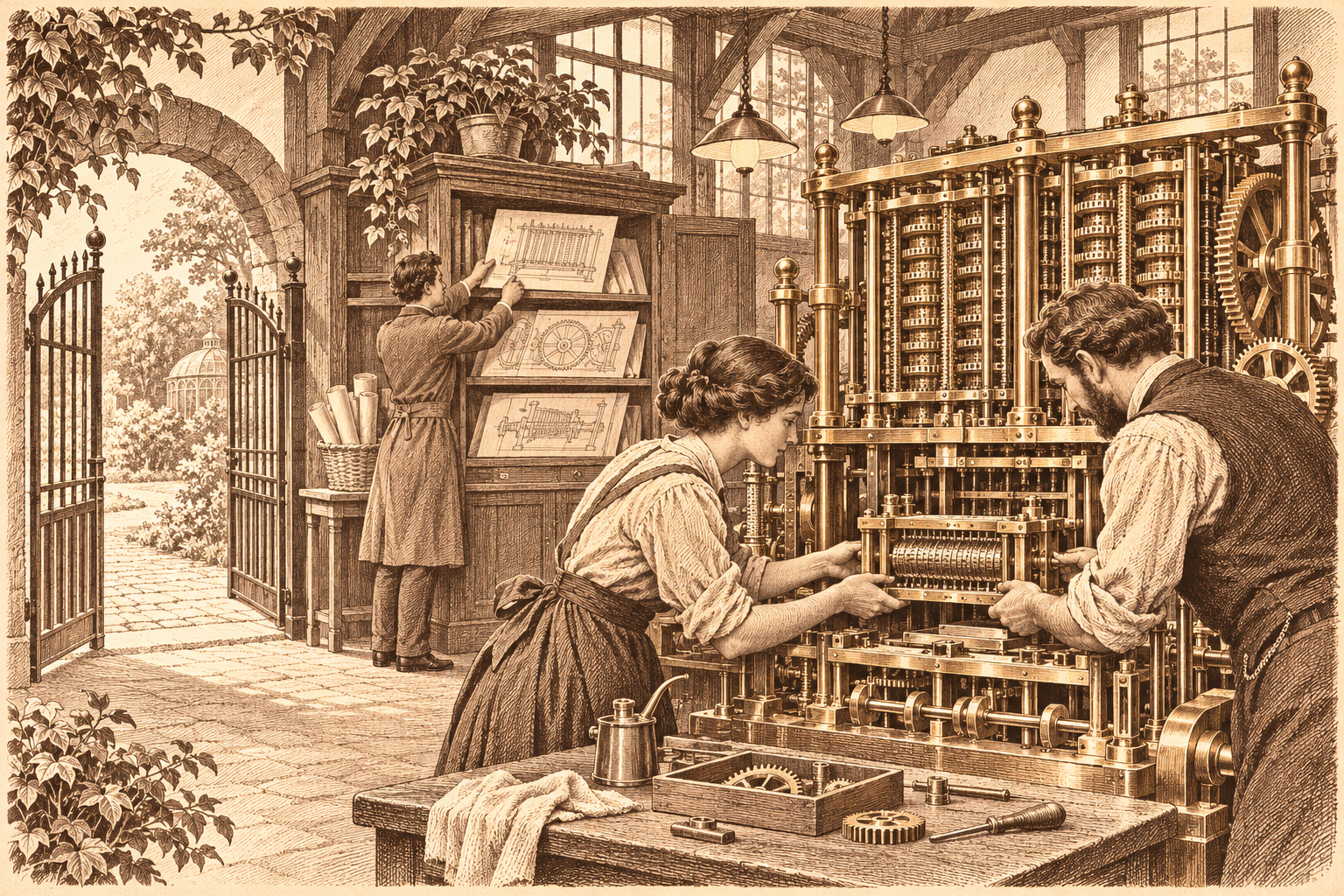
AI-generated editorial illustration · Shared machinery takes maintenance, not just admiration.
James Calligeros’s November 7 progress report ↗ says Asahi is beginning a transition of its repositories to GPLv2-or-later, with strong-copyleft licensing for future Asahi code. It describes attempts to appropriate and commercially replace the project as a motivation. Those allegations are the project’s account, not independently investigated findings. ThePrimeagen’s in-window reaction ↗
This is an announced transition, not confirmation that every repository notice has already changed. We have not audited individual licenses or contributor permissions; the license accompanying the exact code remains essential to check.
The report also says Thunderbolt support is now shipping downstream, but only for USB3, XDomain, and Thunderbolt networking. PCIe and DisplayPort tunneling are not supported yet. “Thunderbolt works” would therefore be an incomplete description for someone expecting a typical dock to work fully.
The Gazette’s reading: two different boundaries make this report useful. One describes the licensing terms the project wants for its work; the other describes what the hardware implementation actually does. Neither is adequately captured by an all-or-nothing label.
Open-source progress includes keeping a group able and willing to maintain the work. Licensing choices are one part of that debate, while upstream reviews, missing features, and ordinary repairs remain the daily engineering. A project can be both making substantial progress and candid about what is unfinished.
Nov 7 project report · Repository transition and technical scope attributed to Asahi Linux · No license audit, hardware test, or legal assessment performed.
We did not run a relevance evaluation or verify his time estimate. His follow-up ↗ argues that deciding what to fix can matter more than acquiring a “software factory.” The Gazette’s reading: a specific recurring inconvenience is an excellent project brief. A fast build is interesting; finding the right result consistently is the outcome to measure next.
The performance comparison in the announcement is an author claim, not a result we can substantiate from that page. This is a project to watch, not a recommendation to migrate a codebase or a claim that a documented, production-ready toolchain has shipped.
Omarchy / Nov 7 · Work in progress
Deep sleep is getting attention—not a release date.
DHH’s update ↗ points to early low-power sleep measurements on an M1 Air and floats the possibility of a first version next week. That is an experimental report and a tentative hope, not a shipped feature or an independently reproduced battery result.
The useful distinction is between a promising measured state and an everyday workflow that reliably sleeps and resumes. We have not tested the hardware or established which devices a future release would support.
Today in computer history · November 8
A birthday behind the integrated circuit
1923 · Jack Kilby is born
A large legacy from very small components.
Jack Kilby was born on November 8, 1923 in Jefferson City, Missouri. The Computer History Museum credits him and Robert Noyce as co-inventors of the integrated circuit. Today marks Kilby’s birthday, not the date of the invention.
The museum describes Kilby’s early integrated circuit as a sliver of germanium with five components connected by wires. It also notes Noyce’s contribution to making the approach practical. Even a technology famous for integration had an early form whose connections were easy to see.
Longer conversations about building software with agents, and the workflows around them. Today’s random feature rotates independently of headline selection; the channel’s newest visible upload is older than this edition’s news window.
Random draw: source 25 of 28. Actual channel image retrieved today.